
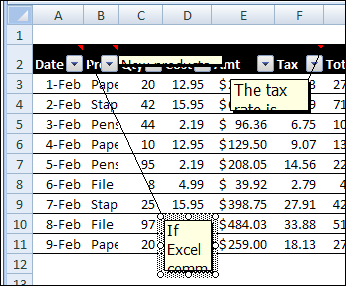
Do you ever open an Excel workbook, and find that tragedy has struck your comments? You spent hours inserting those comments, and making them just the right size and shape. Then, for no apparent reason, everything changes. Comments are in the wrong place, and wrong size. Here’s how to fix those wandering Excel comments.
Make a Valentine Card in Excel
 Yes, it’s Valentine’s Day today, and if you were too busy to buy your sweetie a card yesterday, you can make one in Excel. Phew!
Your boss won’t mind if you spend a couple of hours working on this today, because it’s an Excel project! This Excel Valentine card uses a named range, data validation, a formula, and conditional formatting (to change the heart from white to pink to red).
If you won’t have time, or if your drawing skills are worse than mine, you can download the sample Excel Valentine file, at the end of this blog post.
And if you want some romantic music in the background, while you work on your Excel Valentine card, you can listen to the YouTube playlist, compiled by John Walkenbach and his blog readers.
Set Up the Worksheet
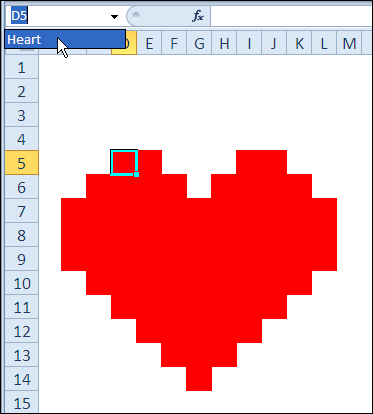
To create the heart shape,
- Start by making columns A:M narrower, to create square cells
- Then, add red fill colour to cells in rows 5:14, to create a heart shape
- Select the coloured cells, and name the range as Heart
Add the Formula
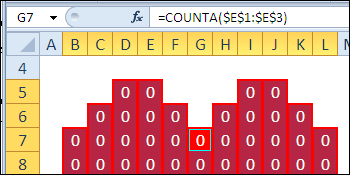
The formula will count how many text items have been added at the top of the worksheet, and the result is used for conditional formatting.
- Select the Heart range
- Type the following formula, then press Ctrl+Enter, to enter the formula in all the selected cells:
=COUNTA($E$1:$E$3)
Add Conditional Formatting
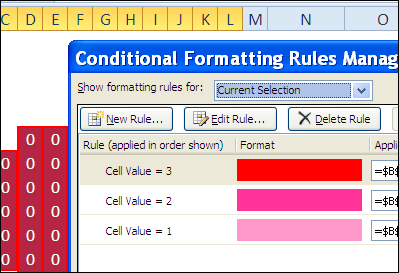
With the Heart range still selected, set up the following conditional formatting:
- =1, light pink fill and font
- =2, dark pink fill and font
- =3, red fill and font
Hide the Heart
The heart shape will be hidden, and only revealed when the Valentine message is selected.
To hide the heart:
- Select the Heart range
- Format the cells with white fill and font.
Add the Data Validation Drop Downs
Next, you’ll create three drop downs, for the Valentine message at the top of the worksheet.
To prepare the cells for the drop down lists:
- Merge cells E1:I1, E2:I2, E3:I3 (yes, merging can cause problems, but it’s allowed on Valentine’s Day)
- Tip: After you merge E1:I1, drag the Fill Handle, to copy the formatting down to the next two rows.
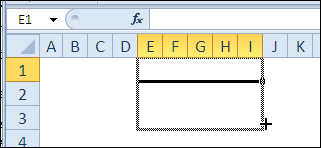
- Add a bottom border to each merged cell, with red or dark pink border colour.
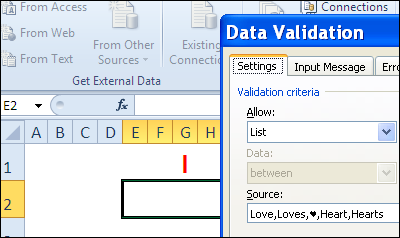
Create the following data validation drop down lists:
- E1: I, You, Everyone
- E2: Love, Loves, ?, Heart, Hearts
- E3: You, Me, Excel
Tip: To type a heart shape, press Alt and type a 3 on the number keypad (if no number keypad, try Fn+Alt+L). On a Mac, another key combination might be needed.
Use the Excel Valentine
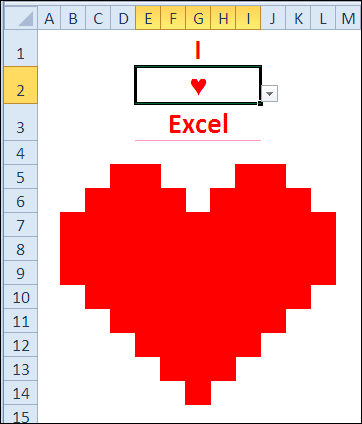
The Excel Valentine heart has white fill and white font, so it’s not visible.
To see the heart:
- Select one item from the drop down lists, to colour the valentine light pink
- Select two items from the drop down lists, to colour the valentine dark pink
- Select three items from the drop down lists, to colour the valentine red
Download the Excel Valentine Card
To see how the card works, you can download the Excel Valentine Card sample file.
The file is in Excel 2007 format, and zipped, and it contains no macros.
_____________
How to Crash Excel
This week, I’ve been working in an Excel 2007 file that has several named Excel Tables. After adding a column in one table, I copied the entire worksheet column.
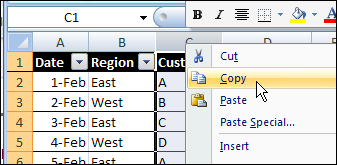
Next, I tried to paste it into another worksheet, where there was a similar table.
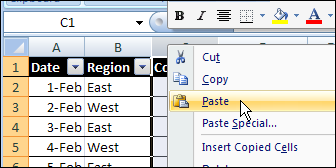
That didn’t go too well. After a few minutes of staring at the hourglass, I gave up, and closed Excel in the Task Manager.
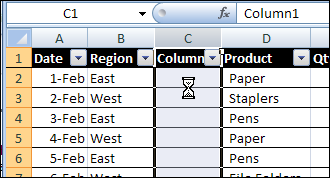
Today, I tried to repeat the column copy and paste, forgetting about the previous problem.
Sure enough, Excel crashed again. Well, technically, I guess it’s a hang, rather than a crash, but it’s still annoying.
A Smaller Named Excel Table
In a smaller workbook, with smaller tables, the copy eventually completed, but with strange results. There was a strange message in the Status Bar.
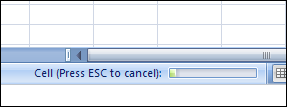
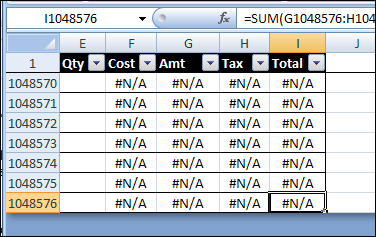
Eventually, the copy completed, but instead of the ten rows from the original table, the paste filled the entire column, so the named Excel Table ended in the last row.
Successful Copy and Paste
Instead of copying and pasting the entire column, you can copy and paste the named Excel table column.
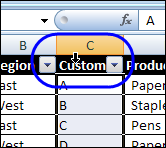
- To select the table column, click, the top of the table heading cell, instead of the column heading button.
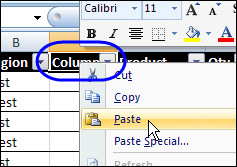
- Then, to paste into the other table, right-click the heading cell, and paste.
Or you can copy the cells, and paste them, instead of copying and pasting the column.
How Do You Crash Excel?
Enough about my problems! What’s your favourite way to crash/hang Excel?
________________
Dynamic Excel Drop Down List
 On Monday, AlexJ showed us how to create a short or long drop down list in Excel. With his technique, users can see just the top customers, or all customers.
That technique didn’t require macros — it was driven by a formula in the data validation source.
Long or Short List Macro
Today, Alex shares an automated version of the short or long data validation list technique. Starting in the next section, you can read his description of how this version works.
You can download the zipped Dynamic Data Validation Sample File from the Contextures website. The file contains macros, so enable them to use the dynamic drop down list.
Dynamic Data Validation Lists
For an Excel utility running at our office, users are required to enter a project number using a drop down list. There are thousands of these records in the data set, selecting from hundreds of project numbers. This means that the drop-down list is long, and therefore not very useful.
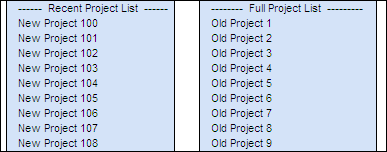
To address this, we determined that the user would usually select from a short list of active projects, but would also need to select from a long list of all projects or old projects.
Use a Single Drop Down
There are a number of techniques using dependent data validation in Excel, but these usually require two selection boxes, we wanted to do this with only a single drop down selection.
The technique presented allows the user to select from a default list of entries, or select a different list.
How It Works
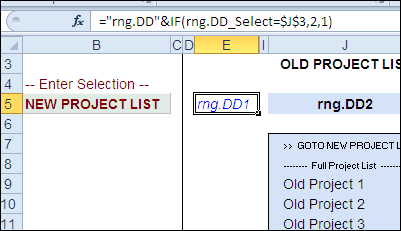
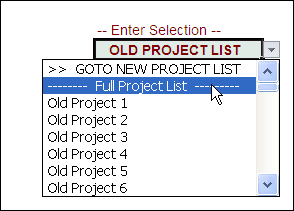
The two lists are named — rng.DD1 for the new projects, and rng.DD2 for the full project list. The first cell in each list is a formula, that refers to the other list.
=”>> GOTO ” & $J$3
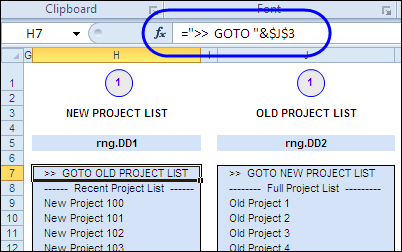
The cell with the drop down list is named rng.DD_Select.
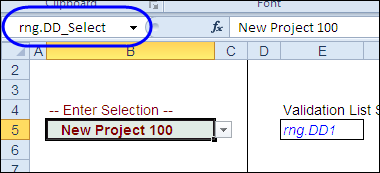
Calculate Which List Selected
The result cell, $E$5, calculates which list has been selected:
=”rng.DD”&IF(rng.DD_Select=$J$3,2,1)
If the selected item matches the heading in cell J3, the result is rng.DD2, otherwise, the result is rng.DD1.
The Data Validation
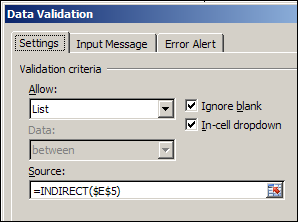
The data entry cell has data validation configured for a list, and the following formula that refers to the result cell:
=INDIRECT($E$5)
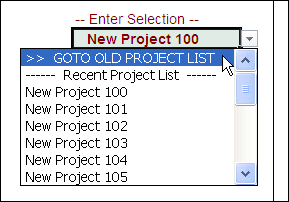
If the result in cell $E$5 is rng.DD1, the new project list is shown.
The Programming
The data validation doesn’t require programming, but there is a small VBA routine triggered by the Change Event in cell B5. It tidies up the data entry cell, after a selection is made.
This routine will:
- Clear any entries from the list where the user has selected “——–”, or a list header like “—– xxxx ——–”
- Convert a selection like “>>>> GOTO NEW PROJECT LIST” to “NEW PROJECT LIST”
Excel Event Code
Here is the event code from the data entry sheet.
Private Sub Worksheet_Change(ByVal Target As Range)
Dim str As String
Dim strNew As String
Const strMatch As String = ">> GOTO "
If Target.Address = Me.Range("rng.DD_Select").Address Then
  str = Target.Value
  If str Like "-*" Then
    Target.ClearContents
  Else
    If str Like strMatch & "*" Then
      strNew = Right(str, Len(str) - Len(strMatch))
      Target.Value = strNew
    End If
  End If
End If
End Sub
________________
Short or Full Excel Drop Down List
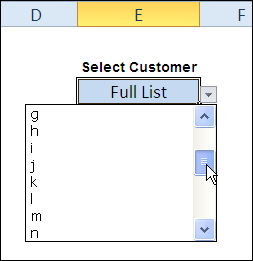
You can make data entry easier in Excel, by create a drop down list with data validation. Sometimes those lists are so long, that they become a pain to use.
Here’s a technique from AlexJ, that lets users switch between a short or full Excel drop down list of customers.
Excel Function Friday: Football Fun
Apparently there is a big football game this weekend in the USA. They’re using Excel for the game — XLV. That’s a really old version, but at least it has multiple sheets and VBA!
ROMAN Function
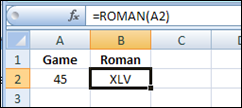
The officials probably used the Excel ROMAN function to figure out how to show the game number — 45:
=ROMAN(A2)
While you’re watching the game, you can use an Excel function to convert the field size from yards to metres. You’ll see that the American field is smaller than the Canadian field, no matter what measurement system you use!
Convert Metres to Yards
There is a CONVERT function in Excel, that you can use to convert measurements from one system to another.
=CONVERT(number,from_unit,to_unit)
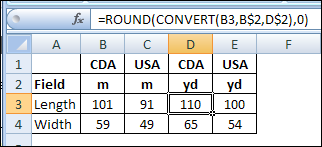
For example, cell B3 has the length of a Canadian field in metres. In cell D3, the following formula converts that measurement to yards, and rounds the result:
=ROUND(CONVERT(B3,B$2,D$2),0)
Unfortunately, the CONVERT function does not get you an extra point.
Other Differences
Besides the size of the fields, there are other key differences between Canadian and American football.
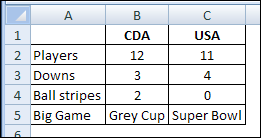
No stripes? Fewer players? More downs? You call that a game? 😉


Speaking of Excel 5.0
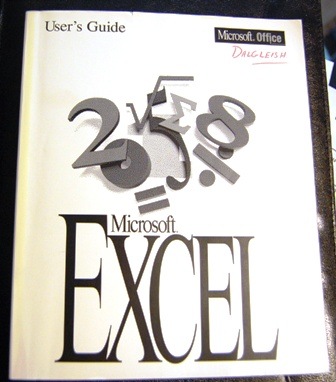
Do you remember when printed manuals came with the software? I still have my Excel 5.0 User Guide, so maybe I can read it while watching the big game!
There were tons of new features in that version, so there will be lots of interesting stuff to read.
________________
Excel Bingo Card Random Number Code
A couple of years ago, I posted about an Excel bingo workbook, that you could use to create a set of three cards with random numbers.
Bingo Card Formulas
In the Excel workbook, the bingo card sheet uses the INDEX and MATCH functions to pull the numbers from another sheet.
- =INDEX(Numbers!$M$1:$M$15, MATCH(LARGE(
Numbers!$N$1:$N$15, ROW()-1), Numbers!$N$1:$N$15,0))
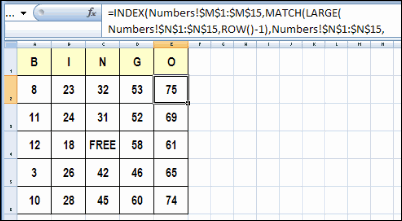
There were a few follow up workbooks, including an Excel Bingo Number Selector file from Dick Kusleika.
Horizontal Number Lists
This week, Carrie posted a comment on that article, and she wanted to adapt the bingo cards so they could be printed with Adobe InDesign. Instead of a square with 25 numbers, that program needs the 25 numbers in a single row.
Using the example in the screen shot above, the numbers in the first two rows would be arranged like this, followed by the numbers from the remaining rows:

Random Number Code
Jim Cone pitched in, and wrote some code to generate the random numbers in single rows, but it created some duplicates in the rows. Carrie didn’t want an uprising in the bingo hall, so we sent Jim away to try again. 😉
It didn’t take long for him to return with some code that worked correctly, so Carrie, and her Hummel figurine collecting friends, can safely play bingo this summer.
Whew! A bit later, Dick posted an update for Jim’s code. It’s shorter, and does the job very well.
Copy the Random Number Code
Thanks Jim and Dick! I’m sure Carrie appreciates the code, and maybe it will help a few other people.
To use this random number code, copy it to a regular code module in your workbook.
Then, go to a blank sheet, and run the SurelyYouCantBeSerious_R1 code.
Sub SurelyYouCantBeSerious_R1()
'Generates 800 sets of random Bingo numbers with no duplicates.
'Each row contains an individual set of Bingo numbers.
'Designed to be used with the "Adobe InDesign" application.
'Jim Cone - Portland, Oregon USA - February 02, 2011
'[email protected] - remove all "X"
'Edited by Dick dailydoseofexcel.com
On Error GoTo DontCallMeShirley
Dim arrList(1 To 800, 1 To 25) As Long
Dim j As Long
Dim R As Long
'B COLUMNS
'1 to 15 in the B column
Randomize
For R = 1 To 800
  For j = 1 To 5
    FillList arrList, j, R
  Next j
Next R
Range("A1:Y800").Value = arrList()
  Exit Sub
DontCallMeShirley:
  Beep
  Resume Next
End Sub
'==========
Sub FillList(ByRef arrList As Variant, lStart As Long, R As Long)
Dim j As Long
Dim C As Long
Dim N As Long
Dim arrCheck(1 To 75) As Long
j = 1
For C = lStart To 25 Step 5
  Do While j < 6
    'Int((High - Low + 1) * Rnd + Low)
    N = Int(Rnd * 15 + ((lStart - 1) * 15 + 1))
    If arrCheck(N) < 1 Then
      arrList(R, C) = N
      arrCheck(N) = N
      j = j + 1
      Exit Do
    End If
  Loop
Next C
End Sub
______________
Turn Off Filters in Excel Table
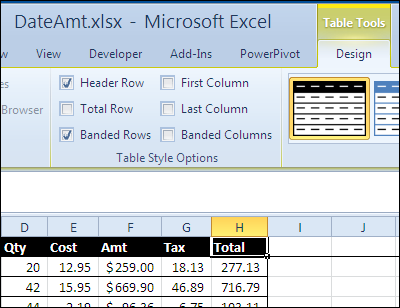
Now that the 30 Excel Functions in 30 Days challenge has ended, it’s time to look at a few other features. On the Contextures page on Facebook, Lee suggested AutoFilters as a topic for some February posts. Thanks Lee! Here’s how to turn off filters in Excel table headings.
30 Excel Functions in 30 Days: Conclusion
Thanks for participating in the 30XL30D challenge, that ended yesterday.
My favourite Excel function in the series was INDEX — I learned a few useful tricks while researching that one! How about you?
Continue reading “30 Excel Functions in 30 Days: Conclusion”
30 Excel Functions in 30 Days: 30 – INDIRECT
 Congratulations! You made it to the final day in the 30XL30D challenge. It’s been an long, and interesting, journey, and I hope you learned a few useful things about Excel functions along the way.
Tomorrow, I’ll do a wrap-up article, and let you know how the functions ranked in the pre-challenge voting, last month.
INDIRECT Function
For day 30, we’ll examine the INDIRECT function, which returns the reference specified by a text string.
This is one of the ways that you can create a dependent data validation drop down list, where, for example, the selection in the Country drop down controls the choices in the City drop down.
So, let’s take a look at the INDIRECT information and examples, and if you have other tips or examples, please share them in the comments.
Function 30: INDIRECT
The INDIRECT function returns the reference specified by a text string.
How Could You Use INDIRECT?
The INDIRECT function returns the reference specified by a text string, so you can use it to:
- Create starting reference that doesn’t shift
- Create reference to static named range
- Create reference from sheet, row, column info
- Create array of numbers that doesn’t shift
INDIRECT Syntax
The INDIRECT function has the following syntax:
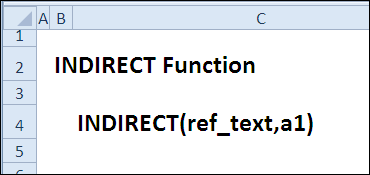
- INDIRECT(ref_text,a1)
- ref_text is the text string for a reference.
- a1 if TRUE or omitted, uses an A1 reference style; if FALSE, the R1C1 reference style is used
INDIRECT Traps
- The INDIRECT function is volatile, so it could slow down your workbook, if used in many formulas.
- If the INDIRECT function creates a reference to another workbook, that workbook must be open, or the formula will result in a #REF! error.
- If the INDIRECT function creates a reference to a range outside the row and column limit, the formula will result in a #REF! error. (Excel 2007 and Excel 2010)
- The INDIRECT function cannot resolve a reference to a dynamic named range
Example 1: Create starting reference that doesn’t shift
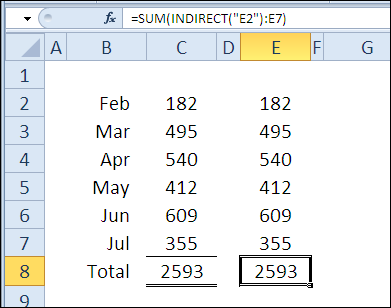
In the first example, there are identical numbers in columns C and E, and the totals are the same, using the SUM function. However, the formulas are slightly different. In cell C8, the formula is:
=SUM(C2:C7)
In cell E8, the INDIRECT function creates a reference to the starting cell, E2:
=SUM(INDIRECT(“E2”):E7)
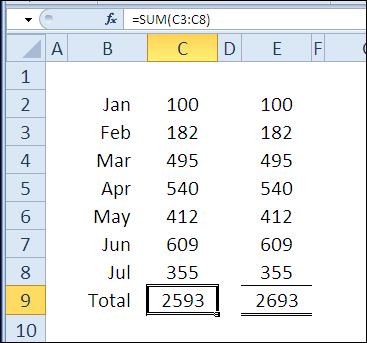
If a row is inserted at the top of the lists, and January amounts are entered, the total in column C doesn’t change. The formula changed, adjusting to the inserted row:
=SUM(C3:C8)
However, the INDIRECT function locked the starting cell to E2, so the January amount is automatically included in the column E total. The ending cell changed, but the starting cell wasn’t affected.
=SUM(INDIRECT(“E2”):E8)
Example 2: Create reference to static named range
The INDIRECT function can also create a reference for a named range. In this example, the blue cells are in a range named NumList. There is also a dynamic range in column B, based on the count of numbers in that column.
The total for either range can be calculated, by using the range name with the SUM function, as you can see in cells E3 and E4
=SUM(NumList) or =SUM(NumListDyn)
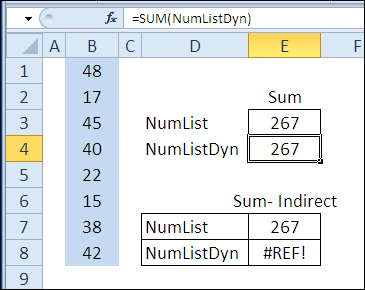
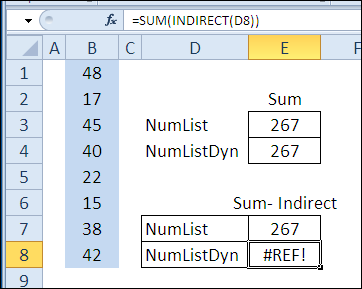
Instead of typing the name in the SUM formula, you can refer to the range name in a worksheet cell. For example, with the name NumList in cell D7, the formula in cell E7 is:
=SUM(INDIRECT(D7))
Unfortunately, the INDIRECT function can’t resolve a dynamic range, so when the formula is copied down to cell E8, the result is a #REF! error.
Example 3: Create reference from sheet, row, column info
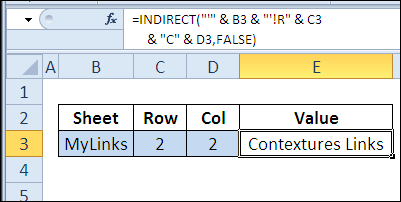
You can easily create a reference based on row and column numbers, by using FALSE as the second argument in the INDIRECT function.
This creates an R1C1 style reference, and in this example, a sheet name is also included — ‘MyLinks’!R2C2
=INDIRECT(“‘” & B3 & “‘!R” & C3 & “C” & D3,FALSE)
Example 4: Create array of numbers that doesn’t shift
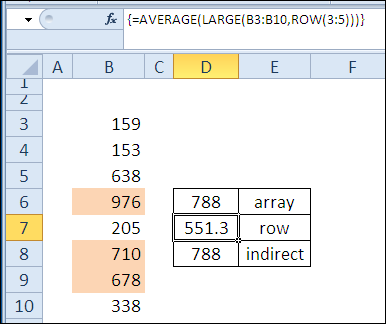
In some formulas, you need an array of numbers, as in this example, where we want the average of the 3 highest numbers in column B. The numbers could be typed in the formula, as they are in cell D4:
=AVERAGE(LARGE(B1:B8,{1,2,3}))
If you need a bigger array of numbers, you probably wouldn’t want to type all of them. Another option is to use the ROW function, as in the array-entered formula in cell D5:
=AVERAGE(LARGE(B1:B8,ROW(1:3)))
A third option is to use the ROW function with INDIRECT, as in the formula in cell D6, which is also array-entered:
=AVERAGE(LARGE(B1:B8,ROW(INDIRECT(“1:3”))))
The results for all 3 formulas are the same.
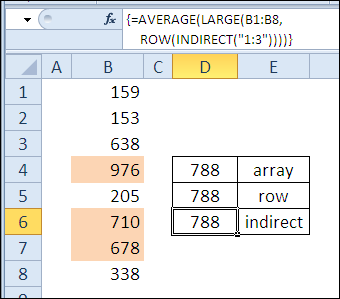
However, if rows are inserted at the top of the sheet, the second formula returns an incorrect result, because the rows are adjusted. Now, instead of the average of the top 3 numbers, it shows the average of the 3rd, 4th and 5th largest numbers.
With the INDIRECT function, the third formula keeps the correct row reference, and continues to show the correct result.
Download the INDIRECT Function File
To see the formulas used in today’s examples, you can download the INDIRECT function sample workbook.
The file is zipped, and is in Excel 2007 file format.
Watch the INDIRECT Video
To see a demonstration of the examples in the INDIRECT function sample workbook, you can watch this short Excel video tutorial.
_____________