Excel Slicers for Easy Pivot Table Filtering

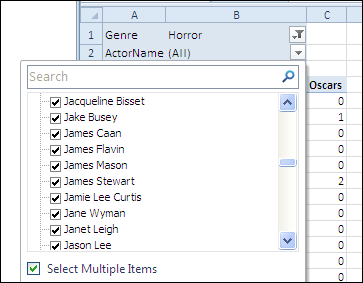
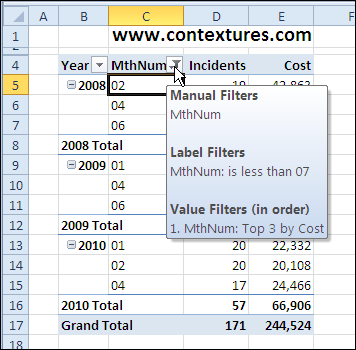
Slasher movies are a scary Halloween tradition, and you can fight back against these horror films, by using Excel Slicers to slash through piles of data.

The Guardian recently posted a list of Greatest Films of All Time. Let’s see how we can use Excel Slicers for Halloween horror films from that list.

Continue reading “Excel Slicers for Easy Pivot Table Filtering”

Get Details in Excel VBA Code

Did you ever get an Excel file from someone else, and try to sort out their Excel VBA code? Or, even worse, open an Excel file that you wrote long ago, and try to remember what all those variables mean?

I spend lots of time staring at Excel code, but apparently I don’t use the right-click menu too often, because I hadn’t noticed a couple of handy commands until recently.

These commands can help you decipher that mysterious code, and unravel the complicated sections.

Excel VBA Quick Info

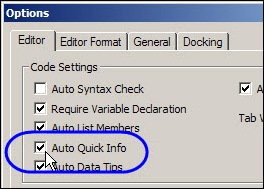
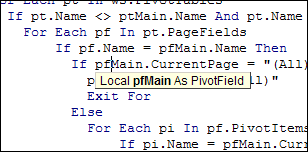
The first handy command is Quick Info. I have Auto Quick Info turned on in the VBE Editor options, and it helps me remember the syntax as I type the code.

excelvbainfo00

Right-Click for Quick Info

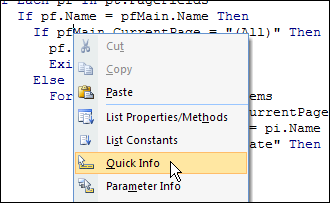
What I didn’t realize was that you can right-click on a variable, function, statement, method, or procedure in the code, and click Quick Info.

Right-Click for Quick Info in Excel Visual Basic Editor

A tooltip appears, with details on the selected item.

excelvbainfo02

Excel VBA Definition

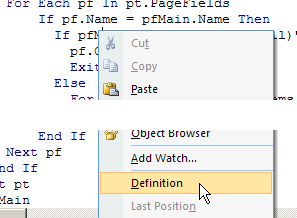
The other right-click command that I finally discovered is the Definition command.

excelvbainfo03

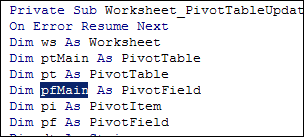
Click the Definition command, and it takes you to the selected variable’s definition.

Finding the definition is easy in most procedures, but in a long procedure, with a long list of variables, the Definition command really makes the job easier.

It’s especially helpful if the variable is defined on a different code module!

excelvbainfo04
___________

Excel Error – Selection Is Too Large

To fill blank cells, or delete rows with blanks cells, you can use Excel’s Go To Special feature.
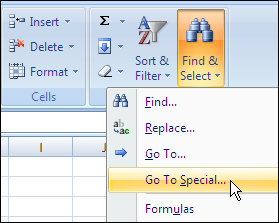
FillBlankCode01

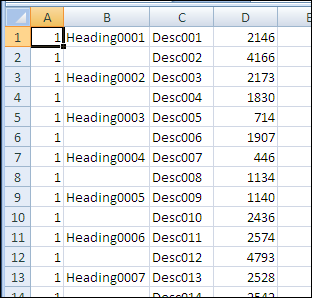
For example, in the worksheet shown below, you might want to fill in all the blanks in column B, by copying the value from the row above.
FillBlankCode00

There are instructions on the Contextures website to fill blank cells, by using Go To Special to select the blanks.

You can do this manually, and there’s sample code to make the job easier.

Selection Is Too Large Error

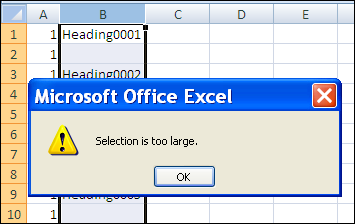
This technique works very well, unless you’re trying to fill blank cells in a long list. In that case, you might see the error message, “Selection is too large.”
FillBlankCode03

This happens in Excel 2007, and earlier versions, because there is a limit of 8192 separate areas that the special cells feature can handle. (This problem has been fixed in Excel 2010.)

There are details on Ron de Bruin’s website: SpecialCells Limit Problem.

Work in Smaller Chunks

If you run into this error, you can work with smaller chunks of data instead.

  • If you’re making the changes manually, select a few thousand rows, instead of the full column.
  • If you’re using a macro, you can loop through the cells in large chunks, e.g. 8000 rows, instead of trying to change the entire column.

On the Contextures website, Fill Blank Cells Macro – Example 3 checks for the number of areas, using Ron’s sample code, and uses a loop if necessary.

The code is shown below, and it shows a message box if the range is over the special cells limit. You can remove that line — it’s just there for information.

Sub FillColBlanks()
'https://www.contextures.com/xlDataEntry02.html
'by Dave Peterson  2004-01-06
'fill blank cells in column with value above
'2010-10-12 incorporated Ron de Bruin's test for special cells limit
'https://www.rondebruin.nl/specialcells.htm
Dim wks As Worksheet
Dim rng As Range
Dim rng2 As Range
Dim LastRow As Long
Dim col As Long
Dim lRows As Long
Dim lLimit As Long
Dim lCount As Long
On Error Resume Next
lRows = 2 'starting row
lLimit = 8000
Set wks = ActiveSheet
With wks
   col = ActiveCell.Column
     'try to reset the lastcell
   Set rng = .UsedRange
   LastRow = .Cells. _
     SpecialCells(xlCellTypeLastCell).Row
   Set rng = Nothing
    lCount = .Columns(col) _
            .SpecialCells(xlCellTypeBlanks) _
            .Areas(1).Cells.Count
    If lCount = 0 Then
        MsgBox "No blanks found in selected column"
        Exit Sub
    ElseIf lCount = .Columns(col).Cells.Count Then
		   'this line can be deleted
        MsgBox "Over the Special Cells Limit" 
        Do While lRows < LastRow
            Set rng = .Range(.Cells(lRows, col),  _
            .Cells(lRows + lLimit, col)) _
             .Cells.SpecialCells(xlCellTypeBlanks)
            rng.FormulaR1C1 = "=R[-1]C"
            lRows = lRows + lLimit
        Loop
    Else
        Set rng = .Range(.Cells(2, col),  _
            .Cells(LastRow, col)) _
            .Cells.SpecialCells(xlCellTypeBlanks)
        rng.FormulaR1C1 = "=R[-1]C"
    End If
   'replace formulas with values
   With .Cells(1, col).EntireColumn
       .Value = .Value
   End With
End With
End Sub

_______________

Spreadsheet Day 2010 — Top 5 Excel Tips

Remember, Sunday October 17th is Spreadsheet Day, so you’d better start planning your celebrations. You could start the day with a big bowl of Chex cereal — each bite looks like a little spreadsheet. For dessert at the end of the day, have some pie, or bars, while you dream about charts.

Continue reading “Spreadsheet Day 2010 — Top 5 Excel Tips”

Excel VBA – Macro Runs When Worksheet Changed

Are you ready for Spreadsheet Day on October 17th?

Maybe you can add a Spreadsheet Day message to all your workbooks, using the technique described in this blog post.

It’s a macro that runs every time the worksheet changed. I’m sure your co-workers would enjoy that!

Continue reading “Excel VBA – Macro Runs When Worksheet Changed”

FLOOR Function – Round Down in Excel

Earlier this week, you read about the Top 100 Canadian Singles, and saw the pivot table that summarized the top songs by decade.

In the comments, Martin mentioned the FLOOR function, that I used to calculate each song’s decade, based on its release year.

File Downloads Fixed

Martin also pointed out that the files weren’t downloading, and I finally managed to fix that — sorry about the inconvenience.

Take my advice, and don’t work on your blog while travelling, if you can avoid it! Things that work perfectly at home, refuse to cooperate when you’re on the road.

FLOOR It

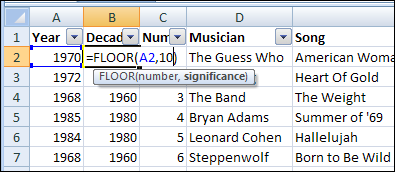
The Excel FLOOR function rounds numbers down, toward zero, based on the multiple of significance that you specify. In the Canadian Music file, the decade is being calculated, so 10 is used as the multiple.

  • =FLOOR(A2,10)

FloorFunction01

In column B, you can see the result of the FLOOR function, rounding down the year for each song, to show the song’s decade.

Trouble on the FLOOR

In the FLOOR function, if the number and multiple have different signs, the result is the #NUM! error. The FLOOR function works well in the music example, because the song’s year is always a positive number.

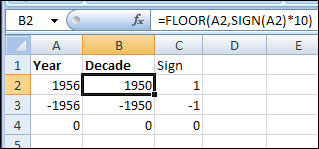
If you’re working with a list that contains both positive and negative numbers, you could use the SIGN function to calculate the number’s sign, and change the multiple to match it.

=FLOOR(A2,SIGN(A2)*10)

FloorFunction02

The Excel SIGN function result is 1 for positive number, -1 for negative numbers, and 0 for zero.

Heart of Gold

And finally, for your Friday listening pleasure, here is the second song on the Top 100 Canadian Singles list — Neil Young playing Heart of Gold.

____________