
If you want to create a pivot table from data on different worksheets, you can use a Multiple Consolidation Ranges pivot table. However, that creates a pivot table with limited features and functionality.
Last year, Excel MVP Kirill Lapin (aka KL) shared his brilliant code to create a Union query and build a fully functional pivot table from data on different worksheets.
More Pivot Table Macros
Now, Kirill is back to share two more pivot table macros, and I’m sure you’ll be impressed by both of them. In today’s example, he’s written a macro to create a pivot table from multiple Excel files.
This is based on a solution that Kirill posted in one of Russian-speaking Excel forums for generating a standard pivot table from multiple workbooks (as opposed to worksheets in the same workbook).
The Report Workbook
The main file is named Report.xls, and it contains Kirill’s pivot table code, and a button that runs the macro. When you open the file, enable the macros, then click the Create Pivot button.
The Data Files
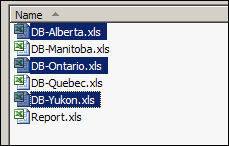
When you run Kirill’s macro, it prompts you to select one or more data files, all stored in the same folder. In this example, the files for Alberta, Ontrio and Yukon are selected.
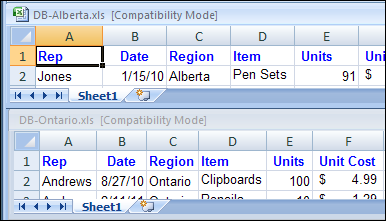
All of the data files must have the same structure, and the macro works with the data stored on Sheet1 in each file. In the screen shot below you can see Sheet1 in the Alberta and Ontario files, which have identical column headings.
The Pivot Table
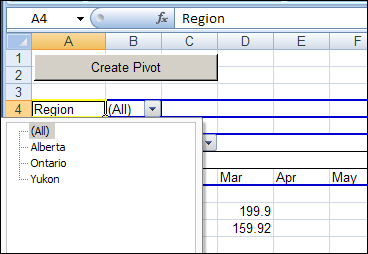
After you select the files and click Open, the macro creates a pivot table based on the data from Sheet1 in each of the selected files. Because the pivot table is based on a Union query, and not built from Multiple Consolidation Ranges, it’s a fully functioning pivot table, and you can pivot, group and filter the data, as usual.
You can also refresh the pivot table, to show the latest data in the source files, as long as those files stay in their original location.
The Union Query
Kirill’s macro creates a Union query to combine the data from all the selected files. If you open Microsoft Query, you can see the SQL string for the Union query, and all the data from the selected workbooks.
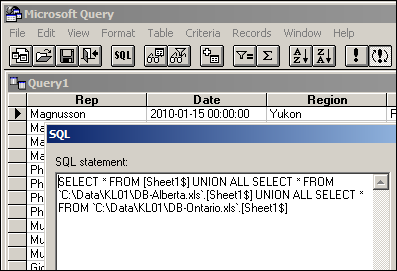
Download the Sample File
To see Kirill’s pivot table code, you can download the Pivot Workbooks example. The zipped folder that contains the Report.xls file, and the five sample data files.
Unzip the folder, and keep all the files in the same folder. When you open the Report.xls file, enable macros to run the code.
Pivot Table Macro #2
Come back on Wednesday to see Kirill’s second pivot table macro. It’s another creative twist on creating a pivot table from data in different workbooks.
______________
I keep getting this message can anyone help asap:
“Excel cannot complete this task with available resources.Chose less data or close other applications.
I only had excel open no other application.
Please help me
Yasin
Thanks a lot Kirill Lapin KL … You made my work easy.
Please help, the code cannot run in 64-bit system.
The code is really great. However when I try to create a pivot from multiple data tables with 132 columns ist stops with an error.
The tables have identical structure and the same column headings.
The error: 1004: [Microsoft][ODBC Excel Driver] Too many fields defined
The debugger shows this line:
Set PT = .CreatePivotTable(TableDestination:= rng (6, 1))
Is there any chance to get around this limit when consoldating data tables from multiple files?
I have a workbook template that contains approximately 6 worksheets and I want to create a pivot out of the first three. This solution fits my ideas perfectly but thats all very new for me and I am struggling to fit the SQL part right to that it refers to the different sheets.
If there is any help, I would be very thankful.
Regards,
Kati
@Kati…easy to fix, but first , a couple of questions:
1. What are the names of the various sheets that you DO want in the pivot
2. do the first 3 worksheets have exactly the same columns?