Yesterday, in the 30XL30D challenge, we got cell details with the CELL function, and learned that it’s useful for a few things, like extracting a worksheet name.
COLUMNS Function
For day 12 in the challenge, we’ll examine the COLUMNS function. Will this function be as useful? Or is it just another lazy function, like AREAS? Well, it does count the columns, as promised, and plays well with others, but nothing too exotic or powerful here.
So, let’s take a look at the COLUMNS information and examples, and if you have other tips or examples, please share them in the comments.
Function 12: COLUMNS
The COLUMNS function returns the number of columns in an array or reference.
How Could You Use COLUMNS?
The COLUMNS function can show the size of a table or named range:
Count columns in an Excel Table
Sum last column in a named range
COLUMNS Syntax
The COLUMNS function has the following syntax:
COLUMNS(array)
array is an array or array formula, or reference to a range.
COLUMNS Traps
If you’re using a range reference, it must be a contiguous range.
Example 1: Count Columns in an Excel Table
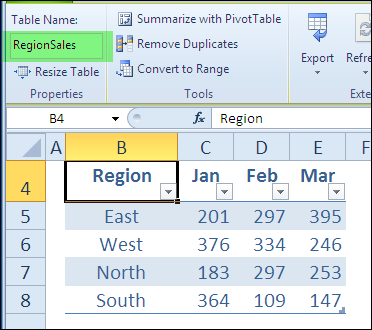
In Excel 2007 and Excel 2010, you can create a formatted Excel table, and refer to its name in a formula. In this example, there is a table named RegionSales,
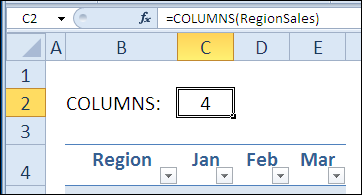
Count Columns in an Excel Table with COLUMNS Function
and the COLUMNS function counts the number of columns in that table.
=COLUMNS(RegionSales)
Example 2: Sum Last Column in Named Range
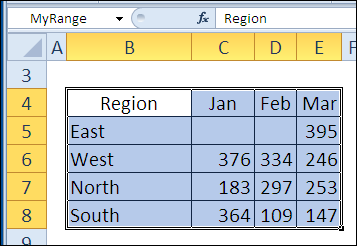
If you combine the COLUMNS function with SUM and INDEX, you can get the total for the last column in a named range. Here, the range is named MyRange,
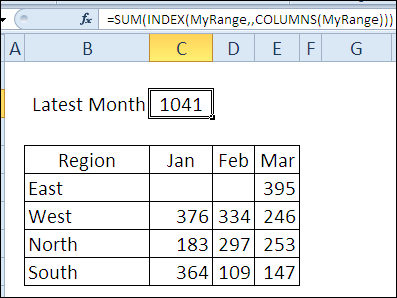
and this formula sums the last column in the named range.
=SUM(INDEX(MyRange,,COLUMNS(MyRange)))
Download the COLUMNS Function File
To see the formulas used in today’s examples, you can download the COLUMNS function sample workbook. The file is zipped, and is in Excel 2007 file format.
Watch the COLUMNS Video
To see a demonstration of the examples in the COLUMNS function sample workbook, you can watch this short Excel video tutorial.
In Day 4 of the 30XL30D challenge, we got details about the operating environment, with the INFO function — things like the Excel version and recalculation mode.
CELL Function
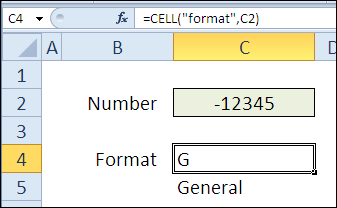
For day 11 in the challenge, we’ll examine the CELL function, which gives you information about cell formatting, contents and location. CELL is similar to the INFO function, with a list of types that you can enter, but has 2 arguments, instead of only one.
For day 10 in the 30XL30D challenge, we’ll examine the HLOOKUP function. Not too surprisingly, this Microsoft Excel function is very similar to VLOOKUP, and works with items that are in a Horizontal list.
Less Popular Than VLOOKUP
Poor HLOOKUP isn’t as popular as its sibling, VLOOKUP, though, because most tables are set up with the lookup values listed vertically.
When was the last time that you wanted to do a horizontal lookup?
Do you ever need to search for a value horizontally, across a row, and then return a value from that column, in a specific row below?
Anyway, let’s give HLOOKUP its moment in the spotlight, and take a look at its information and examples.
Remember, if you have other tips or examples, please share them in the comments.
Function 10: HLOOKUP
The HLOOKUP function looks for a value horizontally, in the first row of a table, and then it returns another value from a different row, in the same column, in that table.
How Could You Use HLOOKUP?
The HLOOKUP function can either find exact matches in the lookup row, or it can find the closest match. For example, an HLOOKUP formula can:
Find the sales total in a selected region
Find rate in effect on selected date
HLOOKUP Syntax
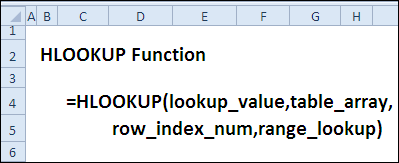
The HLOOKUP function has the following syntax (sequence of arguments):
lookup_value: the value that you want to look for in the first row of the lookup range — it can either be a value, or a cell reference.
table_array: the lookup table — this can be a range reference or a range name, with 2 or more columns in the range. Be sure that the lookup values are in the top row or a table.
row_index_num: the row that has the value you want returned, based on the row number within the table. NOTE: This can be different from the worksheetrow number.
[range_lookup]: for an exact match, use FALSE or 0 in this argument; for an approximate match, use TRUE or 1, with the lookup value row sorted horizontally, in ascending order.
HLOOKUP Traps
Like VLOOKUP, the HLOOKUP function can be slow, especially if you are doing a text string match, in an unsorted table, where an exact match is requested.
Wherever possible, use a table that is sorted by the first row, in ascending order, and use an approximate match, instead of an exact match.
Tip: You can use MATCH or COUNTIF to check for the value first, to make sure it is in the table’s first row. This can make the calculation much faster in some situations.
HLOOKUP Alternatives
Other Excel functions, such as INDEX and MATCH, can be used to return values from a table, instead of HLOOKUP, and those functions are more efficient.
The HLOOKUP function always looks for a value in the top row of the lookup table.
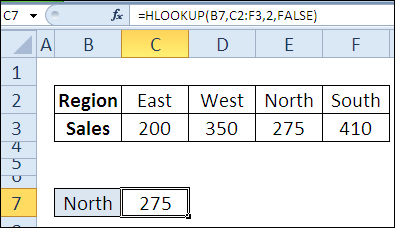
In this example, we will find the sales total for a selected region — East, West, North or South. Those region names are in the first row of the lookup range, and they are NOT sorted in ascending order.
For our financial report, it is important to get the correct sales amount as our formula result, so the following settings the HLOOKUP function will find an exact match.
Worksheet Setup – Example 1
Here are the details on the Excel worksheet setup for this example. You can see the worksheet in the screen shot below:
a region name is entered in cell B7
the region lookup table has two rows, and is in range C2:F3
sales total is in row 2 of the table.
FALSE is used in the last argument, to find an exact match for the lookup value.
The HLOOKUP Formula
The formula in cell C7 is:
=HLOOKUP(B7,C2:F3,2,FALSE)
Find the Sales for a Selected Region with HLOOKUP Function
HLOOKUP Error Result
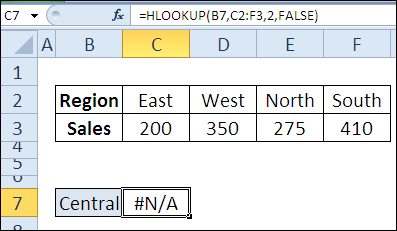
Sometimes, you might get an error resulet with an HLOOKUP formula, as you can see in the screen shot below.
In this case, the region name, “Central”, was not found in the first row of the lookup table, so the HLOOKUP formula result is an error value — #N/A
Example 2: Find Rate for Selected Date
In most cases, an exact match is required when using the HLOOKUP function, but sometimes an approximate match works better.
For example, if rates change at the start of each quarter, only those quarterly dates are entered as column headings. It would not be practical to enter every single date in the heading row!
Instead of trying to find an exact match for the date, with HLOOKUP and an approximate match, you can find the rate that went into effect on the closest date.
Worksheet Setup Notes
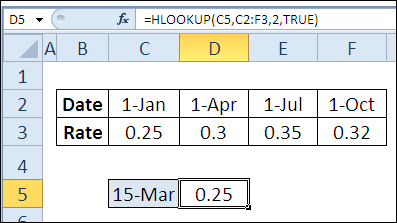
Here are the details on the worksheet setup for Example 2. You can see the worksheet in the screen shot below:
In this example:
a date is entered in cell C5
the rate lookup table has two rows, and is in range C2:F3
the lookup table is sorted by the Date row, in ascending order
dates are in the top row of a table
rate is in row 2 of the table.
TRUE is used in the last argument, so HLOOKUP will find an approximate match for the lookup value.
HLOOKUP Formula Example 2
The formula in cell D5 is:
=HLOOKUP(C5,C2:F3,2,TRUE)
How Approximate Match Works
Here is how the approximate match works, in this example:
If the exact lookup date is not found in the first row of the table, so the HLOOKUP formula finds the next largest value that is less than lookup_value.
The lookup value in this example is March 15th.
That value is not in the date row, so the HLOOKUP function returns the rate for January 1st (0.25).
January 1st is the largest date in the heading row, that is LESS than the lookup date of March 15th
More HLOOKUP Examples
For more HLOOKUP examples, and for tips on fixing HLOOKUP formula problems, go to this page on my Contextures site:
For day 9 in the 30XL30D challenge, we’ll examine the VLOOKUP function. As you can guess by its name, this is one of the Lookup functions, and works with items that are in a Vertical list.
Other functions might do a better job of pulling data from a table (see VLOOKUP traps section below), but VLOOKUP is the lookup function that people try first.
Some people get the hang of it right away, and others struggle to make it work. Yes, this function has some flaws, but once you understand how it works, you’ll be ready to move on to some of the other lookup options.
So, let’s take a look at the VLOOKUP information and examples, and if you have other tips or examples, please share them in the comments. And remember to guard your secrets!
Function 09: VLOOKUP
The VLOOKUP function looks for a value in the first column in a table, and returns another value from the same row in that table.
How Could You Use VLOOKUP?
The VLOOKUP function can find exact matches in the lookup column, or the closest match, so it can:
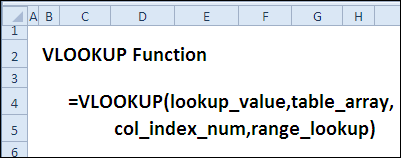
lookup_value: the value that you want to look for — it can be a value, or a cell reference.
table_array: the lookup table — this can be a range reference or a range name, with 2 or more columns.
col_index_num: the column that has the value you want returned, based on the column number within the table.
[range_lookup]: for an exact match, use FALSE or 0; for an approximate match, use TRUE or 1, with the lookup value column sorted in ascending order..
VLOOKUP Traps
VLOOKUP can be slow, especially when doing a text string match, in an unsorted table, where an exact match is requested. Wherever possible, use a table that is sorted by the first column, in ascending order, and use an approximate match.
You can use MATCH or COUNTIF to check for the value first, to make sure it is in the table’s first column (see example 3 below).
Other functions, such as INDEX and MATCH, can be used to return values from a table, and are more efficient. We’ll look at those functions later in the challenge, and see how flexible and powerful they are.
Example 1: Find the Price for a Selected Item
The VLOOKUP function looks for a value in the left column of the lookup table.
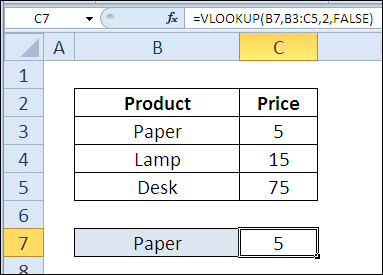
In this example, we’ll find the price for a selected product. It’s important to get the correct price, so the following settings are used:
a product name is entered in cell B7
the pricing lookup table has two columns, and is in range B3:C5
price is in column 2 of the table.
FALSE is used in the last argument, to find an exact match for the lookup value.
The formula in cell C7 is:
=VLOOKUP(B7,B3:C5,2,FALSE)
Find the Price for a Selected Item with VLOOKUP Function
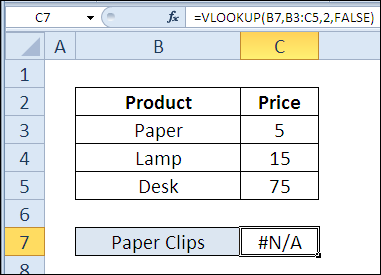
If the product name is not found in the first column of the lookup table, the VLOOKUP formula result is #N/A
Example 2: Convert Percentages to Letter Grades
Usually, an exact match is required when using VLOOKUP, but sometimes an approximate match works better. For example, when converting student percentages to letter grades, you wouldn’t want to type every possible percentage in the lookup table.
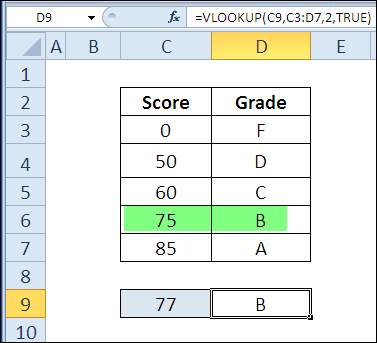
Instead, you could enter the lowest percentage for each letter grade, and then use VLOOKUP with an approximate match. In this example:
a percentage is entered in cell C9
the percentage lookup table has two columns, and is in range C3:D7
the lookup table is sorted by the percentage column, in ascending order
letter grade is in column 2 of the table.
TRUE is used in the last argument, to find an approximate match for the lookup value.
The formula in cell D9 is:
=VLOOKUP(C9,C3:D7,2,TRUE)
If the percentage is not found in the first column of the lookup table, the VLOOKUP formula result is the next largest value that is less than lookup_value.
The lookup value in this example is 77. That value is not in the percentage column, so the value for 75 (B) is returned.
Example 3: Find Exact Price With Approximate Match
The VLOOKUP function can be slow when doing an exact match for a text string.
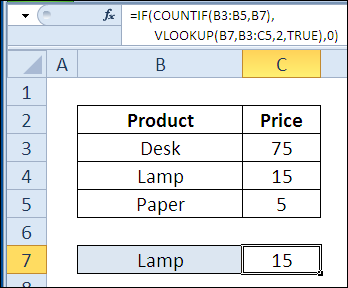
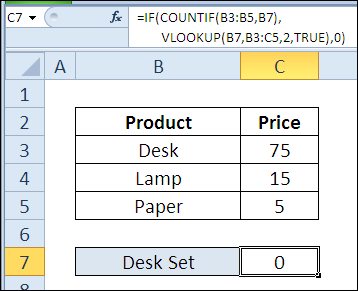
In this example, we’ll find the price for a selected product, without using the Exact Match setting. To prevent incorrect results:
the lookup table is sorted by the first column, in ascending order
COUNTIF checks for the value, to prevent incorrect results
The formula in cell C7 is:
=IF(COUNTIF(B3:B5,B7),VLOOKUP(B7,B3:C5,2,TRUE),0)
If the product name is not found in the first column of the lookup table, the VLOOKUP formula result is 0.
Download the VLOOKUP Function File
To see the formulas used in today’s examples, you can download the VLOOKUP function sample workbook. The file is zipped, and is in Excel 2007 file format.
More VLOOKUP Info and Examples
For more VLOOKUP examples, you can visit the VLOOKUP page on the Contextures website.
Check out Chandoo’s blog, where he had an entire VLOOKUP week, with tips and examples.
For suggestions on speeding up a lookup formula, see Charles Williams’ page on Optimizing Lookups.
Watch the VLOOKUP Videos
To see a demonstration of the examples in the VLOOKUP function sample workbook, you can watch these 2 short Excel video tutorials.
Congratulations! You’ve made it to the first weekend in the 30XL30D challenge, including yesterday’s investigation of the FIXED function.
CODE Function
We’ll take it easy today, and look at a function that doesn’t have too many examples — the CODE function. It can work with other functions, in long, complicated formulas, but today we’ll focus on what it can do on its own, and in simple formulas.
So, let’s take a look at the CODE information and examples, and if you have other tips or examples, please share them in the comments. Wear your secret deCODEr ring, if you have one.
Function 07: CODE
The CODE function returns a numeric code for the first character in a text string. For Windows, the returned code is from the ANSI character set, and for Macintosh, the code is from the Macintosh character set.
How Could You Use CODE?
The CODE function can help unravel mysteries in your data, such as:
What hidden character is at the end of imported text?
How can I type a special symbol in a cell?
CODE Syntax
The CODE function has the following syntax:
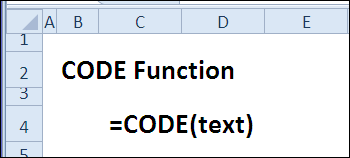
CODE(text)
text is the text string from which you want the first character’s code
CODE Traps
Results could be different if you switch to a different operating system. The codes for the ASCII character set (codes 32 to 126) are consistent, and most can be found on your keyboard.
However, the characters for the higher numbers (129 to 254) may vary, as you can see in the comparison charts shown here:
For example, the ANSI code 189 is ½ and for the Macintosh it is O
Example 1: Get Hidden Character’s Code
When you copy text from a website, it might include hidden characters. The CODE function can be used to identify what those hidden characters are.
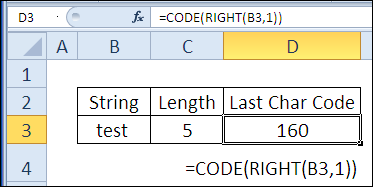
For example, there is a text string in cell B3, and only “test” is visible — 4 characters. In cell C3, the LEN function shows that there are 5 characters in cell B3.
To identify the last character’s code, you can use the RIGHT function, to return the last character. Then, use the CODE function to return the code for that character.
=CODE(RIGHT(B3,1))
Get Hidden Character’s Code with CODE Function
In cell D3, the RIGHT/CODE formula shows that the last character has the code 160, which is a non-breaking space used on websites.
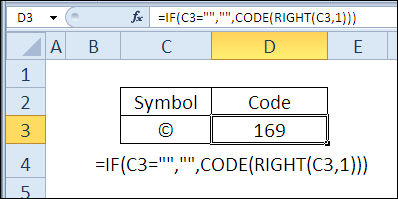
After you insert a symbol, you can determine its code, by using the CODE function
=IF(C3=””,””,CODE(RIGHT(C3,1)))
Once you know the code, you can use the numeric keypad (not the regular numbers) to insert the symbol. The code for the copyright symbol is 169. Follow these steps to enter that symbol in a cell.
On a keyboard with a numeric keypad
On the keyboard, press the Alt key
On the numeric keypad, type the code as a 4-digit number (add leading zeros if necessary): 0169
Press Enter, to see the copyright symbol in the cell.
On a keyboard with no numeric keypad
On your laptop, you might need to press special keys to use the numeric keypad function. Check the owner’s manual, for directions. Here’s what works on my Dell laptop.
Press the Fn key, and the F4 key, to enable NumLock
Locate the numeric keypad within the letters on the keyboard. On my keyboard, J=1, K=2, etc.
Press the Alt key, and the Fn key, and using the numeric keypad, type the code as a 4-digit number (add leading zeros if necessary): 0169
Press Enter, to see the copyright symbol in the cell.
When finished, press the Fn key, and the F4 key, to disable NumLock
Download the CODE Function File
To see the formulas used in today’s examples, you can download the CODE function sample workbook. The file is zipped, and is in Excel 2007 file format.
Watch the CODE Video
To see a demonstration of the examples in the CODE function sample workbook, you can watch this short Excel video tutorial.
Yesterday, in the 30XL30D challenge, we picked an item from a list with the CHOOSE function, and learned that other functions might be a better MATCH when doing a LOOKUP.
FIXED Function
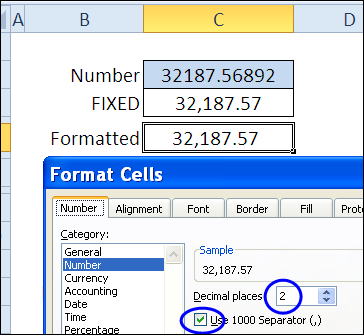
For day 6 in the challenge, we’ll examine the FIXED function, which formats a number with decimals and commas, and returns the result as text.
Yesterday, in the 30XL30D challenge, we got details on our operating environment, with the INFO function, and learned that it can no longer help with our memory issues. (Neither ours, nor Excel’s!)
CHOOSE Function
For day 5 in the challenge, we’ll examine the CHOOSE function.
Yesterday, in the 30XL30D challenge, we cleaned things up with the TRIM function, and learned that it’s no SUBSTITUTE for calorie counting.
INFO Function
For day 4 in the challenge, we’ll examine the INFO function. Excel Help warns us to be careful with this function, or we could reveal private information to other users.
So, let’s take a look at the INFO information and examples, and if you have other tips or examples, please share them in the comments. And remember to guard your secrets!
Function 04: INFO
The INFO function shows information about the current operating environment.
How Could You Use INFO?
The INFO function can show information about the Excel application, such as:
Microsoft Excel version
Number of active worksheets
Current recalculation mode
In previous versions of Excel you could also get memory information (“memavail”, “memused”, and “totmem”), but those type_text items are no longer supported.
INFO Syntax
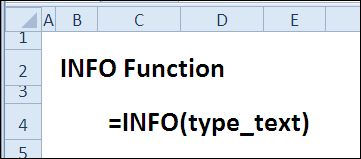
The INFO function has the following syntax:
INFO(type_text)
type_text is one of the following items, that specifies what information you want.
“directory” Path of current directory
“numfile” Number of active worksheets in open workbooks.
“origin” Absolute cell reference of top left visible
“osversion” Current operating system version, as text.
“recalc” Current recalculation mode; “Automatic” or “Manual”.
“release” Microsoft Excel version, as text.
“system” Name of the operating environment: “pcdos” or “mac”
INFO Traps
In Excel’s Help file, there is a warning that you should use the INFO function with caution, because it could reveal confidential information to other users.
For example, you might not want other people to see the file path that your Excel workbook is in. If you’re sending an Excel file to someone else, be sure to remove any data that you don’t want to share!
Example 1: Microsoft Excel version
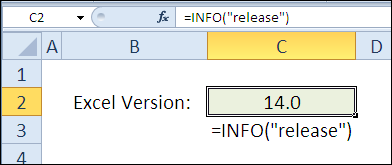
With the “release” value, you can use the INFO function to show what version of Excel is being used. The result is text, not a number.
In the screenshot below, Excel 2010 is being used, so the version number is 14.0.
=INFO(“release”)
Get Microsoft Excel version with INFO Function
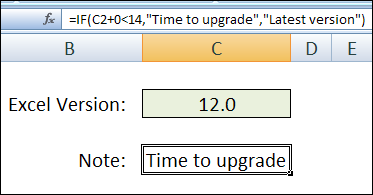
You could use the result to display a message, based on version number. =IF(C2+0<14,”Time to upgrade”,”Latest version”)
Example 2: Number of active worksheets
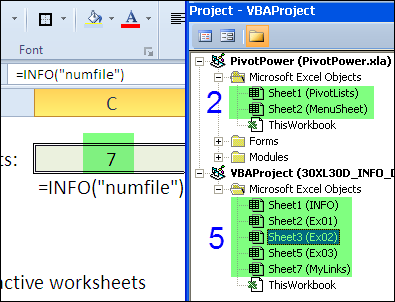
With the “numfile” type_text value, the INFO function can show the number of active worksheets in all open workbooks. This number includes hidden sheets, sheets in hidden workbooks, and sheets in add-ins.
In this example, an add-in is running, and it has two worksheets, and the visible workbook has five worksheets. The total sheets returned by the INFO function is seven.
=INFO(“numfile”)
Example 3: Current recalculation mode
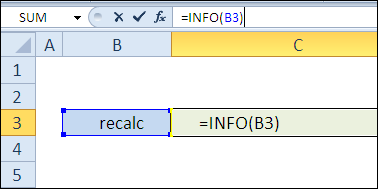
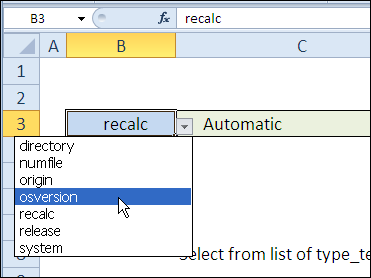
Instead of typing the type_text value as a string in the INFO function, you can refer to a cell that contains one of the valid values.
In this example, there is a data validation drop down list in cell B3, and the INFO function refers to it.
=INFO(B3)
When “recalc” is selected, the result shows that the current recalculation mode is Automatic.
Download the INFO Function File
To see the formulas used in today’s examples, you can download the INFO function sample workbook. The file is zipped, and is in Excel 2007 file format.
Watch the INFO Video
To see a demonstration of the examples in the INFO function sample workbook, you can watch this short Excel video tutorial.