Daily Discounts on Computer Software

The Bits du Jour web site offers one discounted item per day (2 on Tuesdays and Thursdays) — either Windows software or a web service.

You can see the upcoming deals, and download a trial version, to see if it’s worth buying when the discount day arrives. You can also read comments from other users, which might alert you to any problems or questions about a specific product.

The products are ordered directly from the vendor, so you’re buying the full, current version of the product, not a limited version. The products appear to be downloads, so those of us who are outside of the USA shouldn’t have to worry about shipping problems.

A quick visit to the site, once a week, will keep you up to date, and then you can return if you’ve decide to buy something, on the day it’s offered.

Customize Windows Open and Save

Many programs use the Windows Common dialogs which you’ll see when you Open or Save files in those programs.

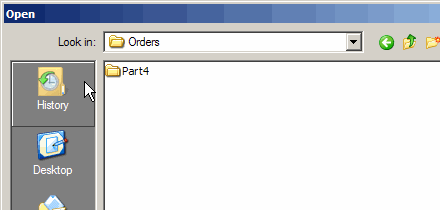
For example, in Notepad, if I select File►Open this dialog appears. The bar at the left is the Places Bar, and it contains 5 standard icons.


Not once, in my entire computing life, have I used that History folder, so it’s just a big waste of space.

The Desktop and My Computer icons aren’t used too often either. Usually I click on My Documents, and hunt for the folder I need. I use the My Pictures folder several times a day, while blogging, so it would be nice to have it one click away.

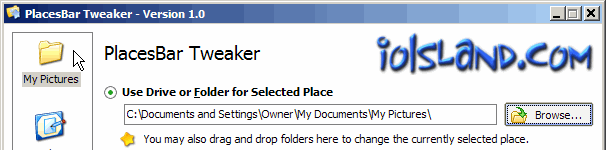
There’s a free utility, PlacesBar Tweaker, that will let you rearrange the folders in the Places Bar, or replace them with folders you prefer.

I removed History and Desktop, and substituted My Pictures and my external hard drive.

The program was simple to download and install, and very easy to use.

  • Click on an icon, then use the arrows to move it up or down in the Places Bar.
  • Or, click on an icon and select a different folder to replace it.


It only took me a few minutes to download and install the utility, and rearrange my Places Bar. I’m sure that investment will pay off very quickly in time saved.

Note: Currently PlacesBar only works for Users who have Administrator privileges.

Speed Up the Start Up

I don’t reboot my desktop computer too often, but when I do, it takes extra time because of all the programs that have elbowed their way into my Startup folder. The system tray fills with the icons for these programs, and I manually disable them, which takes even more time.

After every reboot, I promise myself that I’ll turn off these annoying startups, and limit the programs to those that I actually want or need. Well, my long procrastination is over, and I’m clearing out the riff-raff.

If you’ve been delaying this process too, you can follow these steps to trim the list in your computer’s Startup. I’m using Windows XP, so your system might do things differently.

Remove a Program from the Startup Shortcut List

Some programs appear in the Startup Shortcut list and are easy to delete.
Update: In the comments, Dave suggested moving the startup shortcuts to a different group, so you can restore them easily if you change your mind.

  • Click the Start button in the Windows Taskbar.
  • Click All Programs, then click on Startup
  • Right-click on a program that you want to remove from the Startup list
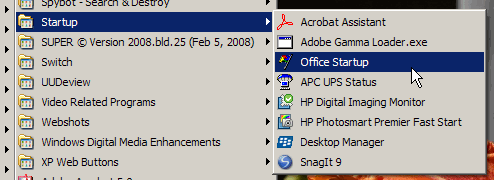
  • Click on Delete, to remove it from the list
  • Click OK, if prompted, to confirm the deletion.

Remove Other Startup Programs

For startup programs that don’t appear in the Shortcuts list, you can change your System Configuration settings. Do this at your own risk!

Only uncheck an item if you’re sure it’s a program that you don’t need running at startup. As a precaution, create a system restore point before changing the System Configuration.

Update: In the comments, Dave suggested that you make a list of the items you’re removing, so you can add them later, if necessary. Good idea, and I’d take a screen shot with SnagIt, since I’m too lazy to write a list. 😉

  • Click the Start button on the Windows Taskbar.
  • Click Run
  • In the Run dialog box, type MSCONFIG and click OK.
  • Go to the Startup tab.
  • Widen the Command column, to see more of the program location details.
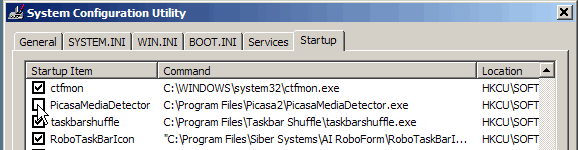
  • If you’re sure that you don’t need the program to run at startup, click on the check box to remove the check mark.
  • Click OK, to close the dialog box, and choose to Exit Without Restart, when prompted.

Show Your Style in Word

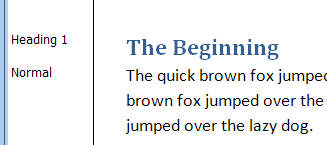
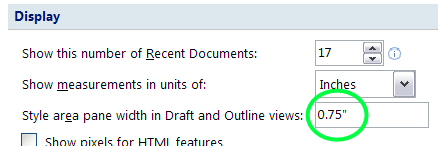
If you use Styles in Word (and you should), did you know that there’s a Style Area at the left of the screen, where you can see the Style names?

This can give you a quick overview when you’re formatting a document, and will help you apply the Styles consistently.

If you don’t use Styles, you can skip to the Random Thoughts section of this article, for a bonus tip. I know, how exciting! 😉

View the Style Area

Word 2007

  1. Choose either Outline or Draft View
  2. Click the Microsoft Office Button, and then click the Word Options button
  3. Click the Advanced Category
  4. In the Display section, set the width for the Style Area Pane, and then click OK

Word 2003 or earlier

  1. Choose either Outline or Normal View
  2. Click the Tools menu, and then click Options
  3. Click the View tab
  4. In the Outline and Normal Options section, set the width for the Style Area, and then click OK.

Hide the Style area

  • Drag the vertical line, between the Style Area and the document, all the way to the left.
  • Or, go back to the Options, and set the width to zero

Random Thoughts

In Excel, you can use the RAND function to calculate random numbers. In Word, you can use RAND to create text.

  1. In the Word document, type: =RAND()
  2. Press the Enter key.
  • In Word 2003 and earlier, you’ll see paragraphs with “The quick brown fox…”
  • In Word 2007, the paragraphs describe Word features.

In either version, you can enter two numbers as arguments in the RAND function, e.g. =RAND(3,4) to control the number of paragraphs (3), and sentences per paragraph (4).

Beyond Bullet Points

If you prepare presentations and use slides, there are interesting ideas in Cliff Atkinson’s book, Beyond Bullet Points.

As the title suggests, he warns against using slides with bullet points. Instead, he uses slides to tell a story, planning them with a storyboard technique.

Atkinson starts by describing a presentation that used the BBP technique to win a major legal case. The rest of the book takes you through the steps of planning, creating and delivering the presentation.

He even suggests handouts with financial data in an Excel spreadsheet, to supplement the presentation, and “quickly establish credibility.”

Incorporating Excel is obviously a smart move in almost any presentation!

I found the book easy to read, with detailed instructions, checklists, tips and examples.

The book comes with a CD which contains templates and checklists to help you get started.

There are also templates and other free resources on the BBP web site, where you can download a couple of chapters from the book, to see if you like it enough to buy it.

Does Music Help You Focus?

I’ve read articles that claim listening to Baroque music will help productivity, and some research concludes that music can make you more productive in repetitive tasks.

When I wrote my books, I usually had flamenco nuevo or contemporary music in my headset, and sometimes listened to the same album several times in a row. (I’m sure that’s not a symptom of anything!) When programming, I like it quiet.

What do you listen to, or do you prefer silence?

If you find that classical music helps you focus, you might enjoy the free concert downloads available at Isabella Stewart Gardner Museum Music:
https://www.gardnermuseum.org/music/listen/music_library

Stick Things Together in Word

This is a feature that I wish Excel had too. If you want to keep two or more paragraphs together on the same page, you can change the formatting options in Word.

To keep two paragraphs together:

  1. Select any paragraph that you want to keep with the paragraph that follows it. For example, click in a heading paragraph, to keep it with the descriptive paragraph below it.
  2. On the Format menu, click on Paragraph
  3. Go to the Line and Page Breaks tab
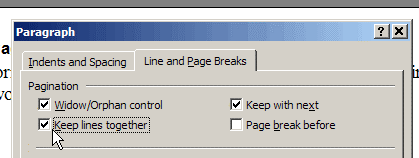
  4. Add a check mark to Keep With Next
  5. Click OK

To keep a paragraph from splitting over two pages:

  1. Click in the paragraph, or select several paragraphs
  2. On the Format menu, click on Paragraph
  3. Go to the Line and Page Breaks tab
  4. Add a check mark to Keep Lines Together
  5. Click OK

Keep a Quick Log File

As I work at my computer, there are lots of things that I want to jot down, to act on later. Most of these are brilliant thoughts, or million dollar ideas, so I don’t want to lose them!

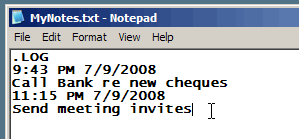
The quickest way that I’ve found to collect these notes is in a log file in Notepad. When I open it, the file adds the current time and date, and the cursor automatically goes to the end of the file.

To create a log file:

  1. Open Notepad, and at the top of the new blank file, type: .LOG
    This MUST be in upper case letters.
  2. Save the file as a Text file, e.g. MyNotes.txt
    Note: I save my file to the Desktop, so it’s easy to find and open.
  3. Close the file.

To use the log file:

  1. Open the log file, and the date and time are automatically added.
  2. Enter your notes, then save and close the file.

Take Measurements With Pixel Ruler

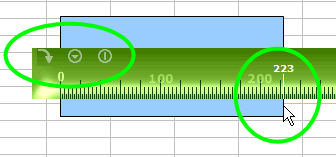
To accurately measure items on your screen you can use the free utility, Pixel Ruler. I’ve found this helpful when I have to upload a picture that’s a specific measurement, such as a blog banner, or profile photo.

You can drag the ruler to any position on the screen, to line up the zero mark with the left edge of the object that you want to measure.

Then, point to the ruler where it lines up with the right edge of the object, to see the width in pixels. In the screen shot above, the rectangle is 223 pixels wide.

The ruler has three control buttons at its top left — an arrow, a triangle and a line:

  • To measure the height, rotate the ruler to vertical, by clicking the arrow button.
  • Click the triangle button to change the ruler colour, or to access the Pixel Ruler web site
  • To close the ruler, click the line button.

Block the Distractions with White Noise

If you’re trying to work in a noisy environment, some white noise might help block out the distracting sounds. I work from home, with an office that faces the street. It’s usually quiet, but when the kids are out of school for the summer, things get a bit noisy sometimes.

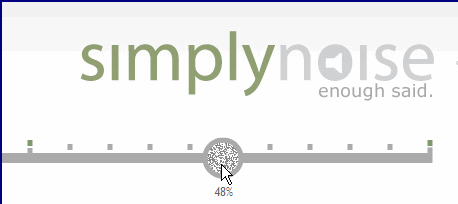
If I’m trying to concentrate, I put on my headset and go to https://www.simplynoise.com/ for some white noise. There’s a slider that let’s me adjust the volume, and that’s it. Nothing to fiddle with, no choice of sounds, just simple noise, as promised.

After a couple of minutes I forget that I have the headset on, the outside sounds fade away, and I can focus on my work again.