
Use INDEX and MATCH together, for a powerful lookup formula. It’s similar to a VLOOKUP formula, but more flexible — the item that you’re looking for doesn’t have to be in the first column at the left. Watch the video to see how it works (there are written instructions too), and download the sample workbook to follow along.
Excel Lookup With Two Criteria
Watch this video to see how INDEX and MATCH work together — first with one criterion, and then with multiple criteria. Download the sample workbook to follow along, and the written instructions are below the video.
- 0:00 Introduction
- 0:26 Lookup with One Criterion
- 1:52 Test Each Criterion
- 2:22 Test With a Formula
- 3:26 Multiply the Results
- 4:03 INDEX / MATCH Formula
- 5:20 Check the Formula
- 5:57 Get the Sample File
Get Item Price with INDEX and MATCH
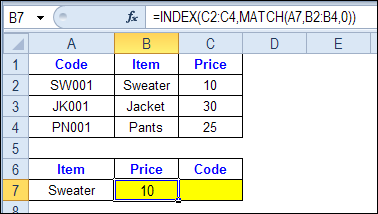
To see how INDEX and MATCH work together, we’ll start with an example that has only 1 criterion. Our price list has item names in column B, and we want to get the matching price from column C.
In the screen shot below, cell A7 has the name of the item that we need a price for – Sweater.
We can enter an INDEX and MATCH formula in cell C7, to get the price for that item:
=INDEX($C$2:$C$4,MATCH(A7,$B$2:$B$4,0))
How the INDEX and MATCH Formula Works
Here’s how the two functions work together:
- MATCH function gets the location of an item in a list
- INDEX function returns a value from a specific location in a list.
So, in our formula:
- the MATCH function looks for “Sweater” in the range B2:B4.
- The result is 1, because “Sweater” is item number 1, in that range of cells.
- the INDEX function looks in the range C2:C4
- The result is 10, from row 1 in that range
So, by combining INDEX and MATCH, you can find the row with “Sweater” and return the price from that row.
Find a Match for Multiple Criteria
In the first example, there was only one criterion, and the match was based on the Item name – Sweater. However, sometimes life, and Excel workbooks, are more complicated.
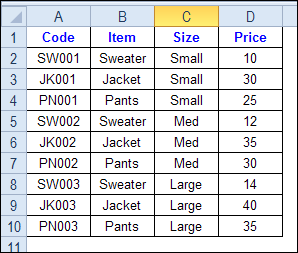
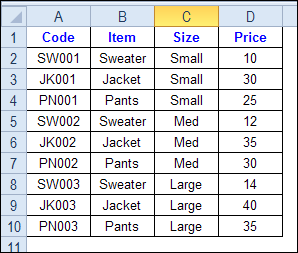
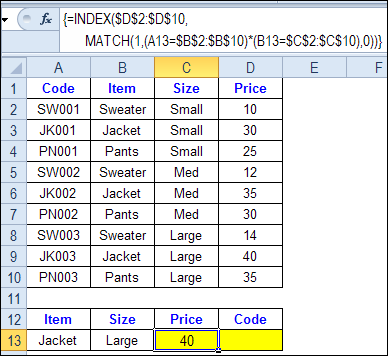
In the screen shot below, each item is listed 3 times in the pricing lookup table. We want to find the price for a large jacket.
To get the right price, you’ll need to use 2 criteria:
- the item name
- the size
Does it MATCH? True or False
Instead of a simple MATCH formula, we’ll use one that checks both the Item and Size columns.
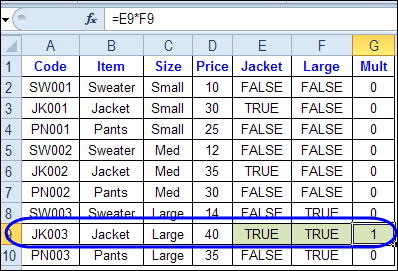
To see how this formula will work, I’ll temporarily add columns to check the item and Size of each item — is the item a Jacket, and is the Size a Large?
Enter this formula in E2, and copy down to E10: =C2=$C$13
Enter this formula in F2, and copy down to F10: =D2=$D$13
- If the Item in column B is a Jacket, the result in column E is TRUE. If not, the result is FALSE
- If the Size in column C is Large, the result in column F is TRUE. If not, the result is FALSE
To see if both results are TRUE in each row, enter this formula in G2, and copy down to G10: =F2*G2
When you multiply the TRUE/FALSE values,
- If either value is FALSE (0), the result is zero
- If both values are TRUE, the result is 1
Only the 8th row in our list of items has a 1, because both values are TRUE in that row.
We can tell the MATCH function to look for a 1, and that will return the information that we need.
Use MATCH With Multiple Criteria
Instead of adding extra columns to the worksheet, we can use an array-entered INDEX and MATCH formula to do all the work.
Here is the formula that we’ll use to get the correct price, and the explanation is below:
=INDEX($D$2:$D$10,
MATCH(1,(A13=$B$2:$B$10) * (B13=$C$2:$C$10),0))
NOTE: This is an array-entered formula, so press Ctrl + Shift + Enter, instead of just pressing the Enter key.
How the Formula Works
In this INDEX and MATCH example,
- prices are in cells D2:D10, so that is the range that the INDEX function will use
- the item name is in cell A13
- the size is in cell B13.
The formula checks for the selected items in $B$2:$B$10, and sizes in $C$2:$C$10. The results are multiplied.
- (A13=$B$2:$B$10)*(B13=$C$2:$C$10)
The MATCH function looks for the 1 in the array of results.
- MATCH(1,(A13=$B$2:$B$10)*(B13=$C$2:$C$10),0)
If you select that part of the formula and press the F9 key, you can see the calculated results. In the screen shot below there are 9 results, and all are zero, except the 8th result, which is 1.

So, the INDEX function returns the price – 40 – from the 8th data row in column D (cell D9).
Get the Product Code
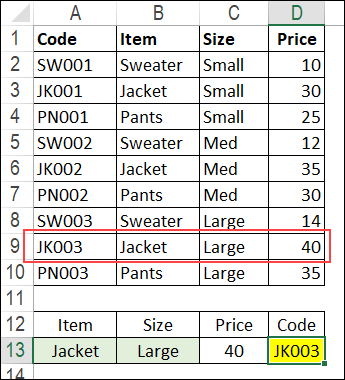
To find the product code for the selected item and size, you would change the formula to look in cells A2:A10, instead of the price column.
Put this formula in cell D13, and remember, this is an array-entered formula, so press Ctrl + Shift + Enter.
=INDEX($A$2:$A$10,
MATCH(1,(A13=$B$2:$B$10) * (B13=$C$2:$C$10),0))
In this example, the product code would be JK003, from cell A9.
Get the Workbook
To get the sample file with the Lookup Multiple Criteria examples, go to the Excel Lookup Multiple Criteria page on my Contextures site.
For more INDEX and MATCH tips and examples, visit the INDEX function and MATCH function page on the Contextures website. This is Example 4 in the sample file section of that page.
_____________
Genius! Thank you! I am using this to calculate a timesheet budget based on hourly rates, day rates, etc. It works perfectly on all except hourly as it keeps coming up 10x the correct amount. Perhaps Excel is telling me I need a raise?
@Robin, a raise is a great idea! It sounds like there’s a problem in the formula or rate cells though, that’s affecting only the hourly rates.
Hello- I am attempting to do something similar…. I am currently using this formula =VLOOKUP(LARGE(A:A,1),A1:M63,12,FALSE). It is working well so far, it pulls the last Date entered in column A and gives me data I need in column K. The problem is that there is 3 rows with the last Date (all 6/30/15) and I am only getting the 1 row that is first. Any ideas? Thanks
In the many examples above, we need to have an exact match. Is there a way I can mark the result as “0” if there is no exact match? I’m trying to subtract the finding if there’s an exact match but my results give me #N/A.
=INDEX(‘sample’!J:J,MATCH(1,INDEX((‘sample2’!$H:$H=$H59)*(‘sample’!$E:$E=$E$7),,),0),1)
Thank you in advance.
Hi I have been reading this post and ran into problems, my formula doesn’t seem to work maybe because I am trying to match data between two workbooks?
So far I have tried the way in the main example, dividing the FIND formula, and the “&” added to the formula…all with no success.
These have been my attempts:
=INDEX(‘[Book1.xlsx]Sheet1′!$J2:$J5294,MATCH(A2&B2,'[Book1.xlsx]Sheet1′!$W2:$W5294&'[Book1.xlsx]Sheet1’!$AE2:$AE5294))
=INDEX(‘[Book1.xlsx]Sheet1′!$J:$J,MATCH(1,(A2=’C:\Users\Desktop\[Book1.xlsx]Sheet1′!$W:$W)*(B2=’C:\Users\Desktop\[Book1.xlsx]Sheet1’!$AE:$AE),0))
In both cases I press Shift+Crtl+Enter and I am looking for a way in which I do not need to specify the range, as the data from “Book1.xlsx” is not always 5294…
I have been stuck on this for a long time…please help 🙁
…if there is an easier way in vba I would like to know as well! 🙂
HI thanks for Sharing excellent tricks.
I also need your help in summing data through selecting multiple option dropdown.
Ex.
My data is in column like April, May,June,…..March.
I created two dropdowns for Months through data validation,
what i want if I select APril in 1st dropdown and May in Second dropdown then data in report sheet should be sum of period between months. same way if I select April in 1st dropdown and june in 2nd dropdown, it should fetch the sum of april+may+june.
please help me if any body have any idea.
Thank in advance
I have attempted to use these formula examples but I can’t get it to work with the files I am using.
I have two separate files that I need to create formula for, similar to a VLOOKUP formula, but that will search for multiple criteria and insert the result when finding an exact match.
The way my 1st excel file appears is:
Parent UPC (Carton) Child UPC (Pack) Item Description
Camel Crush Menthol
The second file contains the data I need to extract from. I would like to write a formula that searches my database file for the description in C2 (Camel Crush Menthol) and, in this second file, an Item size with Carton, and once it finds the results, inserts the the results into A2 (and also B2 when searching for an item size “Pack”)