
A common pivot table question is “How can I create a pivot table from data that’s on separate sheets in my workbook?
Sometime people have a workbook set up with a separate sheet for each region, or for each salesperson.
Eventually, they want to pull all the data together, and create a summary report in a pivot table, from multiple sheets.
Multiple Consolidation Ranges
Excel has a feature (well hidden Excel 2007) that lets you do this, using Multiple Consolidation Ranges.
A pivot table created this way has limited features, and isn’t much use in summarizing Excel data.
I usually recommend that you move all the data onto one worksheet, if it will fit, or store it in a table in Access, then use that as the source for the pivot table.
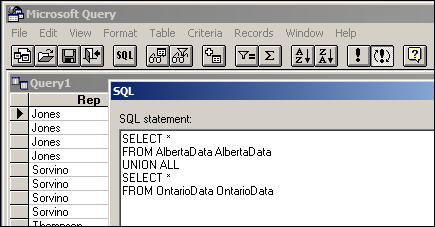
Create a Union Query
Another solution is to create a Union query from the separate tables, and use that as the source data.
Normal Pivot Table
With this solution, you’ll end up with a normal pivot table, with none of the limitations. However, it’s a bit tedious to set up, especially if you have more than a couple of tables.
Automate the Union Query
Instead of setting this up manually, you can use the code in a sample file from Excel MVPs, Kirill Lapin (KL), with amendments by Héctor Miguel Orozco Diaz. (You might remember Héctor’s innovative Filter Pivot Table Source Data example, posted earlier this year.)
To adjust their sample code to work in your file, you’d replace the sheet names in the CreateConnection code.
To go to the CreateConnection code, right-click on the “Create Empty Table” button, and click Assign Macro, then click Edit.
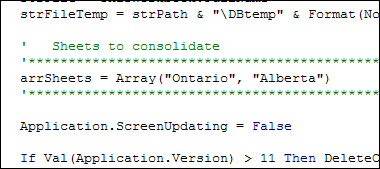
You can also adjust the location where the pivot table will be added. This line is further down in the CreateConnection code.
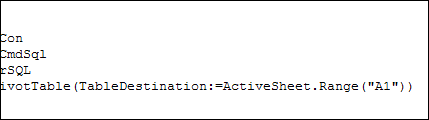
After those small changes, save the code changes. Then go back to Excel, click the button on the worksheet, and a summary pivot table will be automatically created.
Download the Sample File
Thanks Kirill and Héctor, for making a complicated task easier. You can download their sample file from the Contextures website: PT0023 – Pivot Table from Multiple Sheets
(Also, please check the update section below, for a newer version of the file)
Update — December 2011
The solution described in this article was created as a conceptual prototype and targeted mainly advanced VBA users. The code has minimal error handling and compatibility checks.
Given the massive response from all kinds of users willing to adopt this solution in their own applications, we would like suggest a similar solution based on ADO.
Advantages:
- No need for temporary file generation
- The code is faster and less prone to errors
Disadvantages:
- No manual refresh of the PivotTable
- Need to rebuild connection from the scratch to update the cache with new data
Download the ADO Sample File
You can download the new ADO version of the file from the Contextures website: PT0024 – Pivot Table from Multiple Sheets – ADO version
Update — August 28, 2012
In the comments below, Kirill posted code that will automatically detect the sheet names. The blog formatting changed his minus sign to a long dash, and also deleted the Less Than Greater Than operator. Here is the correct code, with Kirill’s instructions:
In the code, replace this line:
' Sheets to consolidate
'*****************************************************************************
arrSheets = Array("310_BWATTS_P Pastujova", "310_BWATTS_Maria Sanchez")
'*****************************************************************************
with the following code:
' Sheets to consolidate
'*****************************************************************************
Dim ws As Worksheet
ReDim arrSheets(0)
For Each ws In ThisWorkbook.Worksheets
  If ws.Name <> ActiveSheet.Name Then
    arrSheets(UBound(arrSheets)) = ws.Name
    ReDim Preserve arrSheets(UBound(arrSheets) + 1)
  End If
Next ws
ReDim Preserve arrSheets(UBound(arrSheets) - 1)
'*****************************************************************************
________________
I have a new project where I am using this functionality again. I am having a heck of a time with 2 areas:
#1. If there is a random space/odd character in a cell, columns won’t sum correctly. they sum fine in normal column totals within the sheets but not on the Pivot…any ideas?
#2. If I refresh the data most of my columns no longer sum and I have to start all over building the PT from scratch…how can I find the issue?
Thanks
Joshua
Hi all
I am really struggling to get this to consistently work. I have a team of 8 people and we all keep daily timesheets to allocate our spend against different projects. Each person has their own pivot but I wanted one pivot to show everyones spend against all projects. I get various errors:
Run time 1004
the code Set PT = .CreatePivotTable(TableDestination:=ActiveSheet.Range(“A56”)) highlights
ODBC Excel Driver Too many field defined
I am copying the code from above and I am clueless as to solve the problem.
I have tried copying the data from the other worksheets by: copy tab, copy and paste to new sheet, copy and paste values.
Help please! It would be much appreciated!!!
Laura
@Laura
How many columns do you tables have and how many tables are you trying to consolidate please?
Regards,
KL
@Joshua,
Problem is SQL is guessing field data types and, if strange characters are found, it will assume string type and won’t sum. You may need to add some data integrity checking/correcting to the code. One option is to use a loop with TextToColumns method of the Range object on each of the numeric fields before making a connection.
Regards,
KL
@Philippe
Could you please place a sample file with this problem on a shared server (e.g. Mediafire) and publish the link so I can have a look?
Thanks,
KL
@Chris,
Could you please give more detail about your problem?
Thanks,
KL