
Is there a harder working team in Excel, than the reliable duo of INDEX and MATCH? These functions work beautifully together, with MATCH identifying the location of an item, and INDEX pulling the results out from the murky depths of data. See how to find text with INDEX and MATCH.
Find Text in a String
Last week, Jodie asked if I could help with a problem, and INDEX and MATCH came to the rescue again.
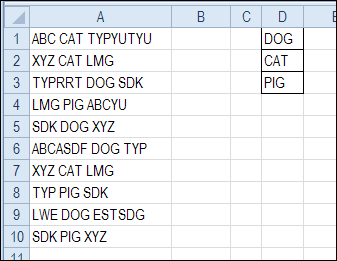
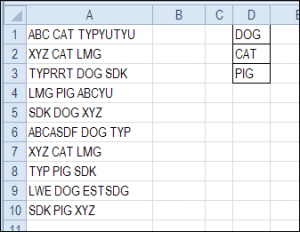
Jodie sent me a picture of her worksheet, with text strings in column A and codes in column D. Each text string contained one of the codes, and Jodie wanted that code to appear in column B.
Would you use INDEX and MATCH to find the code, or another method? Keep reading to see my solution, and please share your ideas, if you have other ways to solve this.
Count the Occurrences With COUNTIF
When you want to find text that’s buried somewhere in a string, the * wildcard character is useful. We can use the wildcard with COUNTIF, to see if the string is found somewhere in the text.
I entered this test formula in cell B1. This formula needs to be array-entered, so press Ctrl + Shift + Enter.
=COUNTIF(A1,”*” & $D$1:$D$3 & “*”)
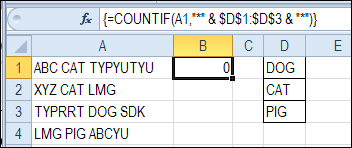
There are wildcard characters before and after the cell references to D1:D3, so the text will be found anywhere within the text string.
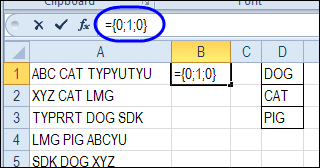
To see the results of the array formula, click in the formula bar, and press the F9 key. The array shows 0;1;0 so it found a match for CAT, which is in the second cell in the range, $D$1:$D$3.
- Important: After you check the results, press the Esc key, to exit the formula without saving the calculated results.
Get the Position With MATCH
Next, you can add the MATCH function, wrapped around the COUNTIF formula, to get the position of the “1” in the results.
Make the following change to the formula in cell B1, and remember to press Ctrl + Shift + Enter.
=MATCH(1,COUNTIF(A1,”*”&$D$1:$D$3&”*”),0)
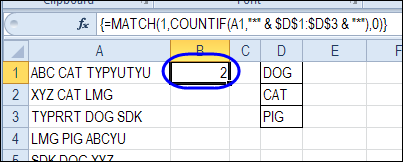
The result is 2, so the code “CAT”, the 2nd item in range D1:D3, was found in cell A1.
Get the Code With INDEX
Next, the INDEX function can return the code from the range $D$1:$D$3, that is at the position that the MATCH function identified.
Make the following change to the formula in cell B1, and remember to press Ctrl + Shift + Enter.
=INDEX($D$1:$D$3,MATCH(1,COUNTIF(A1,”*”&$D$1:$D$3&”*”),0))
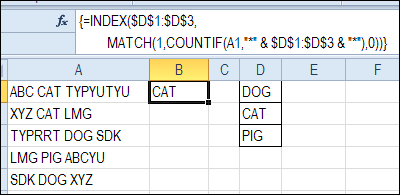
The result is CAT, so the formula is working correctly.
Prevent Error Results With IFERROR
There should be one valid code in each text string, but sometimes the data doesn’t cooperate. Just in case there are text strings without a code, or more than one instance of the code, you can use IFERROR to show an empty string, instead of an error. (Excel 2007 and later versions)
=IFERROR(INDEX($D$1:$D$3,MATCH(1,COUNTIF(A1,”*”&$D$1:$D$3&”*”),0)),””)
Enter with Ctrl + Shift + Enter, and then copy the formula down to row 10.
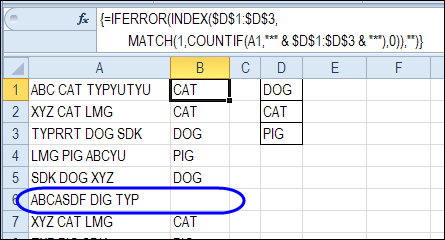
In cell B6, the formula returns an empty string, and the cell looks blank, because none of the valid codes are in the text that’s in cell A6.
Use a Named Range
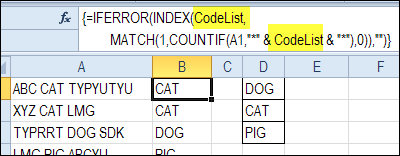
Instead of referring to range $D$1:$D$3, you could name that range, and use the name in the INDEX/MATCH formula. That would make it easier to maintain, if the size of the codes list will change.
Download Find Text With INDEX and MATCH Sample File
To get the sample file, and see how the formula works, go to the INDEX and MATCH page on my Contextures site.
In the Download section on that page, look for sample file 4 – Find Text From Code List. The zipped file is in xlsx format, and does not contain macros.
More INDEX and MATCH Examples
There are more examples of using INDEX and MATCH on my Contextures site.
For example, this video shows how to use INDEX and MATCH to find the best price.
____________________________
Is there a way to get the text instead of the formula in column B in the first example.
Thank you!!!
Jorge
Hello,
I just want to make a comment:
I have seen many ways to solve a problem but THERE IS NOTHING explained as this one.
THUIS IS THE BEST I’VE EVER SEEN IN 20 YEARRS!!!
Thank you so much!!!
Jorge Cue
Hi Debra,
I have tried using the get code with index but excel seems to struggle over 20k rows where string within each cell can be quite long. Can you suggest any alternatives how this formula can work quickly? Many thanks
Hi Debra.
Am I right in thinking that the formula =COUNTIF(A1,”*” & $D$1:$D$3 & “*”) counts the number of cells that contain at least one instance of the codes? Not the number of times the codes appear in each cell?
Any suggestions on how to count the number of times the codes in Column D appear in Column A when the codes can appear multiple times in the same cell?
A1: CAT ABC CAT
A2: XYZ CAT
Expected result: 3
Thanks.
Can anyone here Help me on below sample data
I have more then 1000 entries of repeating names in “data file” these names are to be replaced with codes provided in separate sheet, i have tried lookup function but its not working with this data.
File 1 : “Data File” has this format
Names:
Madiha Siraj
Nayha
Arneeb Farooq
Noreen Huma
Madiha Siraj
Shagufta Parveen
Nayha
File 2: “Codes File”
Names Codes
Dr.Nayha Kahlid 1085
Dr.Madiha Siraj 1081
Dr.Shagufta Parveen 1010
Dr.Arneeb Farooq 1009
Dr.Noreen Huma 1002
Hi Debra, can you provide an spreadsheet where I can see the formulas working? Step 2 “Count the Occurrences With COUNTIF” does not work at all for me. I do always get the excel error #NV, which seems to be an inconsistent cell format