
Did you eat too many Christmas cookies over the holidays? An extra dessert or two?
If it’s time to get back into shape, use this Excel weight loss tracker. It can store weekly weight records, calculate your weight loss, and show your progress in a weight loss chart.
Get the Excel Weight Loss Tracker
There’s a link at the end of this post, where you can download the Excel Weight Loss Tracker sample file.
NOTE: I’m not a trained medical professional, so use the Excel Weight Loss Tracker at your own risk, and for entertainment purposes only, etc.
Choose Your Measurement System
[Update] The latest version of this workbook lets you select pounds or kilograms as the measurement.
There is also a stone/pounds version of this workbook. Read about it here: Excel Weight Loss Tracker in Stone and see the link at the end of this article.
Use the Excel Weight Loss Tracker
On the first worksheet in the Excel Weight Loss Tracker file, there are cells where you can enter your personal data and goals.
In the Excel Weight Loss Tracker sample file, I’ve entered the data for my daughter’s favourite Toronto Blue Jays baseball player. He probably had a few extra cookies over the holidays too, and needs to get in shape before the baseball season starts.
Data is entered in the green cells, and calculations, such as Target Date, are in the white cells.
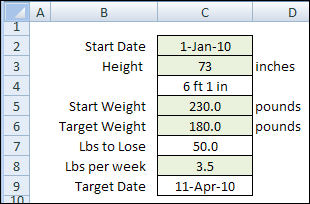
This shows the good news for the Blue Jays. If this player can work off about 3.5 pounds per week, he’ll be ready!
BMI Calculations
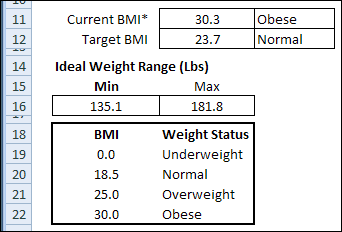
The first sheet in the Excel Weight Loss Tracker also has information on Body Mass Index (BMI) from the Center for Disease Control and Prevention. It calculates your current BMI, and target BMI, and shows the ideal weight range for your height.
The BMI table is used as a lookup table for the ratings for the current BMI and Target BMI. The Minimum and Maximum ideal weight range is calculated from your height, and the Normal range in the BMI table.
Weight Tracking
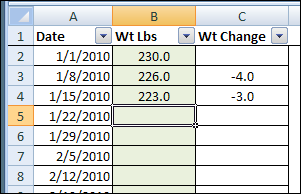
The second sheet is the Weight Tracker sheet, where weekly weights are entered. It also calculates the weekly weight change. Just enter your weight in column B each week, and the change is automatically calculated.
Weight Loss Dashboard
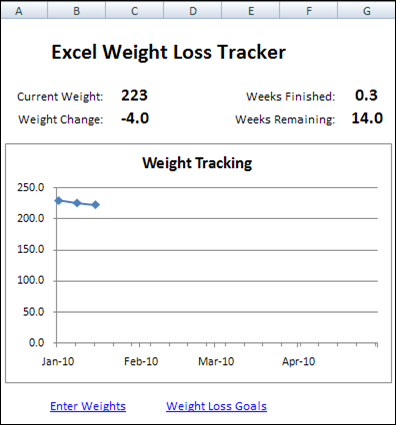
The final sheet is the Dashboard, with a simple line chart to show the recorded weights, and a summary of the weight loss.
It calculates the total weight change, and shows how many weeks are left until you reach the target end date.
Download the Excel Weight Loss Tracker
You can download a zipped copy of the Excel Weight Loss Tracker, and try it for yourself.
The sheets are protected, with the green cells unlocked, and there’s no password on the worksheets.
______________________
Colin, congratulations on your upcoming wedding! You can find the Stone/Pound version here:
http://blog.contextures.com/archives/2010/05/05/excel-weight-loss-tracker-in-stone/
[…] year, you might have seen the Excel Weight Loss Tracker workbook that I posted, which used inches and pounds as its measurements. Even though we use the metric […]
This is great, but i’m wondering if you can add a section that is for measurements of different parts of the body if you’re trying to build muscle. Examples would be Chest/Bust, waist, belly, arms, thighs, etc. It would be great to be able to put in your measurements weekly and see how they change as you work out.
@Michael, thanks for your suggestion — I’ll add that to the list for the next version.
Thank you so much for this. I downloaded a lot of weight tracking spreadsheets, and yours was both the most useful and the best looking.
(I modified it so that I could track my waist measurement too.)
Thanks John, glad you like the workbook, and were able to add another tracking feature.
Thank you so much!!! This will really help me in my New Year’s resolution to get in better shape!