
At a client’s office last week, I was selecting a pricing option from a data validation drop down list. It had some limitations, so here are 3 types of Excel drop down lists compared.
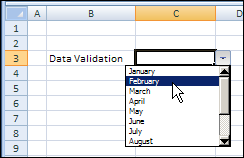
Data Validation Drop Down
At my client’s office, the worksheet was zoomed to 75%, so we could see more of the data, and the person watching over my shoulder asked, “How can you even read that?”
Good question. Sometimes the font in a data validation drop down is so small that you can barely read the list.
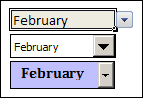
Drop Down Types
Unfortunately, there’s no way to make the font size bigger, which is one of the drawbacks of a data validation drop down list.
There are other ways to create a drop down list though, and one of those options might work better in your worksheet.
We’ll compare these types of Excel drop down lists:
- Data Validation List
- Form Control Combo Box
- ActiveX Control Combo Box
Data Validation Limitations
Data validation is a great feature, and you can use creative formulas to create flexible lists, such as dependent drop down lists. However, it has limitations:
- the font size can’t be changed
- only 8 rows are visible at a time
- only the active cell shows a drop down arrow.
You can’t change those settings, but you can colour the data entry cells, to make them obvious to the worksheet users.
Form Control Combo Box
Instead of using data validation, you could use a Form Control Combo Box. It gives you a bit more control over the appearance of the drop down list.
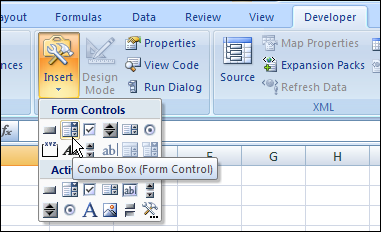
You can adjust the number of drop down lines in the Form Control Combo box, so you can show all 12 months, without a scroll bar.
You can also link the combo box to a cell, so the selected item number appears on the worksheet.
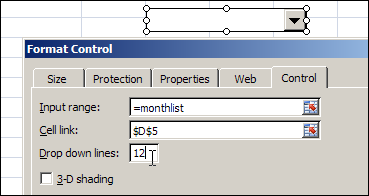
The drop down arrow is always visible, so the Form Control combo box is easy for users to find on the worksheet.
The font size can’t be changed though, so the list would be hard to read on a zoomed worksheet.
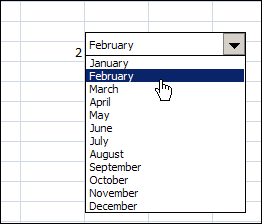
Also, you can’t type in the box, so click the arrow, then select an item from the list. That item’s index number (its position in the list) is entered in the linked cell. In the screen shot above, February was selected, and a 2 is entered in cell D5.
Get the Item Name
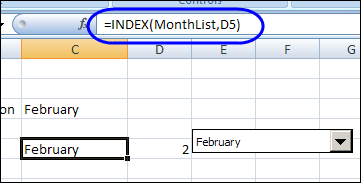
To show the item name, instead of the item number, you can use an INDEX function in another cell.
In this example, the INDEX function returns a month name from the MonthList named range, from the row number (2) for the selected month (February).
ActiveX Combo Box
Another drop down list option is to use an ActiveX combo box. This is similar to the Forms Control combo box, but has more properties that you can adjust.
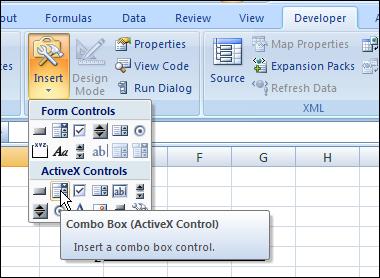
After you insert a combo box, right-click the combo box, and click Properties.
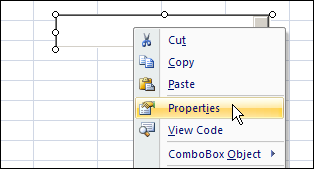
You can set the properties, such as font, font size, number of rows, and even include multiple columns.
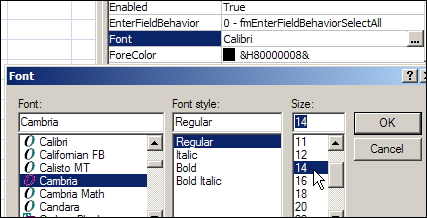
If you know that a worksheet will be zoomed most of the time, you can use a larger font, to make the list easier to read.
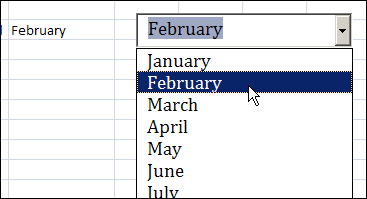
This combo box can also be linked to a worksheet cell, and the value is entered in that cell, when you select an item from the list.
Also, you can type in the combo box, and the text autocompletes as you type, finding the first matching item in the list.
Combine the Drop Down Lists
To make the most of the data validation features, while allowing font changes, autocomplete and more rows, I sometimes combine data validation with a combo box.
There’s only one combo box, hidden at the top of the worksheet, and bit of programming makes the combo box appear when needed.
When a user double-clicks on a data validation cell, the combo box appears, and displays the data validation list for the selected cell. If users don’t want to use the combo box, they can simply click on the arrow in the cell, and use the data validation list.
Watch the Drop Down Lists Video
To see a demonstration of the 3 types of drop down lists, you can watch this Drop Down Lists video.
____________
Will either of these 3 drop-down list’s enable me to choose more than one item in the drop-down list. Example I want the user to be able to choose apples and oranges not just one or the other.
Thanks for your help.
Maggie
Hi, Im trying to create a sheet which has the items which i created as a drop down list. I also do want a description to add to particular item and have aprice for each descriptions. See ex below:
DESCRIPTION ITEMS PRICE
Development cost per set of job $802.00
Reticulation Cost
What I want to achieve is, when I select Development cost from the drop down I should only see per set of job,& reticulaton cost from the drop down. Based on the Items that I select I want the price to be shown automatically in another column. Please advise. I have tried DV with SUBSTITUE & INCORRECT commands. DIdnt work. any suggestion as I have a list of 150 description and around 400 items to populate.
Thanks in advance.
Dea5r Sir,
I need to increase drop doen list font in data validation list .
Regards,
Mundhe
+91 9561094712
I’m using an Excel spreadsheet for a customer questionnaire, utilizing drop down boxes so they can choose the answer (1 – 5) that they want. I need to make some changes and need to capture the drop down box entry (number from 1 to 5) as a literal so I can get the automatic grading sheet to operate properly. Do you know of a way to do that?
@Chuck, if your customer selects a text answer, you should be able to use the INDEX and MATCH functions to return the related number from a lookup table.
There are a few examples on my Contextures site:
http://www.contextures.com/xlFunctions03.html
Excelent work! Thanks!
Is it posible to combine drop down and formulas in excel?